
By Stan Bumgardner
For West Virginia Humanities Council
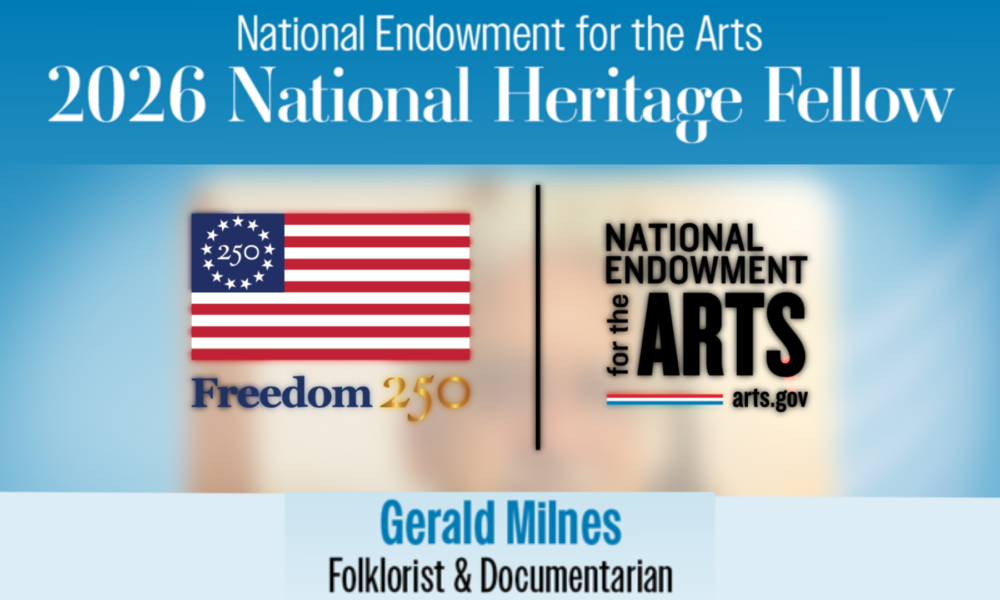
Charleston— Gerald “Gerry” Milnes of Elkins, West Virginia, has been named a 2026 National Endowment for the Arts’ National Heritage Fellow, the nation’s highest honor in the folk and traditional arts. These lifetime awards are given in recognition of both artistic excellence and efforts to sustain cultural traditions for future generations. Milnes was nominated by the West Virginia Humanities Council, where he served as a Board member from 2014 to 2020.
Milnes (b. 1946) is a West Virginia folklorist, author, filmmaker, musician and educator known for his lifelong documentation of traditional Appalachian culture. His work stands out among this year’s fellows as he is receiving the Bess Lomax Hawes National Heritage Fellowship. Named after an influential educator and advocate for the folk and traditional arts, this distinction annually recognizes one person nationally who has made significant contributions to the excellence, vitality and public appreciation of the folk and traditional arts.
A public reception honoring Milnes will be held on Thursday, May 21, 6-8 p.m., at the Humanities Council’s headquarters, 1310 Kanawha Blvd E, Charleston WV 25301.
Eric Waggoner, executive director of the West Virginia Humanities Council, emphasizes the importance of Milnes’s career. “Without Gerry’s dedicated work,” Waggoner says, “many of West Virginia’s songs and stories might otherwise have been lost.”
Milnes began his extensive fieldwork after moving to West Virginia in 1975, recording and studying local musicians, craftspeople, and folk practices. In 1988, he joined the Augusta Heritage Center in Elkins as Folk Art Coordinator. Over the next 25 years there, he created a major archive, including thousands of recordings and photographs documenting music, crafts, customs and daily life.
He has produced albums, documentary films and books on Appalachian folklore, and contributed to projects such as John Sayles’ feature film Matewan and the PBS documentary The Appalachians.
A longtime mentor and performer, he established the West Virginia Folk Arts Apprenticeship Program at Augusta (1989-2009) to help pass on traditional arts. Milnes later participated in the Humanities Council’s West Virginia Folklife Apprenticeship program to impart traditional fiddle techniques, tunes and stories to his apprentice Annick Odom.
“Gerry is a role model,” says state folklorist Dr. Jennie Williams. “When I started my work, I sought out Gerry for guidance, and I have since deeply valued his stories and our friendship.”
You can read more about his career on e-WV.
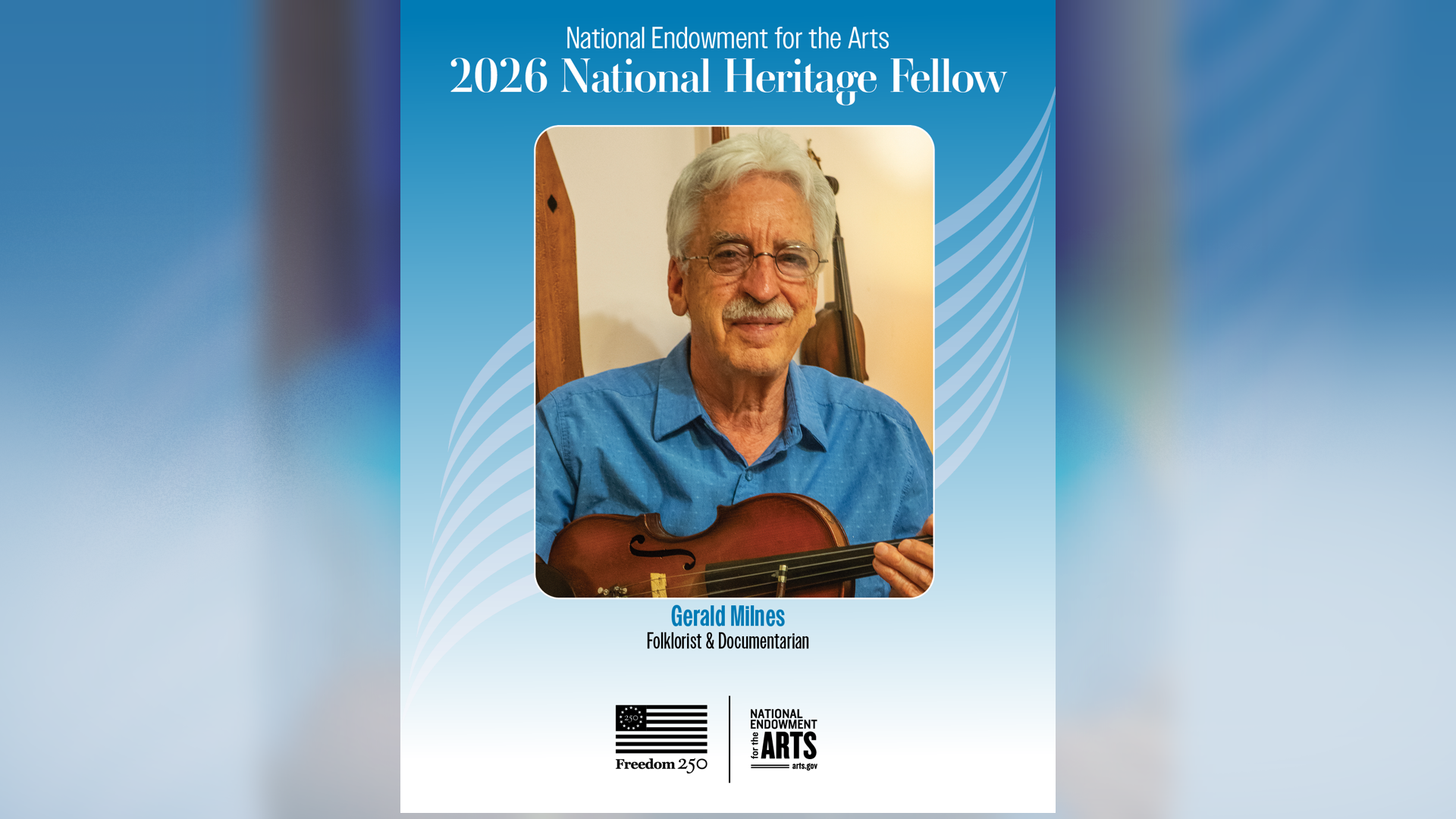
National Heritage Fellows
The other 2026 National Heritage Fellows are Juan Díes and Victor Pichardo, Mexican folk musicians of Chicago; Belen Escobedo, a Conjunto Tejano fiddler from San Antonio, Tex.; Giovanni Hidalgo, a Latin percussionist from Ocoee, Fla.; Lloyd Kumulā‘au Sing, Jr. and May Haunani Balino-Sing, Hawaiian twined basketry artists of Wahiawā, HI; Patrick Olwell, flutemaker of Nellysford, Va.; Frank Rabon, CHamoru dancer and choreographer of Hagåtña, Guam; Cary Schwarz, saddlemaker and leather artist of Salmon, ID.
Milnes is only the seventh West Virginian to receive this recognition. The others were Nimrod Workman (1984), Melvin Wine (1991), Ellie Mannette (1999), Dorothy Thompson (2000), Hazel Dickens (2001), and John Morris (2020), who was also nominated by the Council.
“This award is Gerry’s,” Waggoner adds, “and is well-earned. But it is also a tribute to the tradition bearers who trusted him to listen and to learn, and a boon to the young folk artists and scholars who will help create and document the next generation of West Virginia’s arts and culture.”
Milnes adds, “The hundreds of folk artists I have been privileged to know, document, and learn from speaks to the strength of our state’s traditional arts.”
About the National Endowment for the Arts
Established by Congress, the National Endowment for the Arts is an independent federal agency that is the largest funder of the arts and arts education in communities nationwide and a catalyst of public and private support for the arts. By advancing opportunities for arts participation and practice, the NEA fosters and sustains an environment in which the arts benefit everyone in the United States. Visit arts.gov to learn more.
About the The West Virginia Humanities Council
The West Virginia Humanities Council, an independent nonpartisan nonprofit institution, is the state affiliate of the National Endowment for the Humanities (NEH). With the support of the NEH, the State of West Virginia and contributions from the private sector, the Council supports a vigorous program in the humanities statewide in West Virginia. This year, the Council is celebrating 25 years of its Little Lectures program, the 20th anniversary of its West Virginia Encyclopedia,and the 10th anniversary of its West Virginia Folklife Program.