

By Steven Allen Adams
For The Parkersburg News and Sentinel
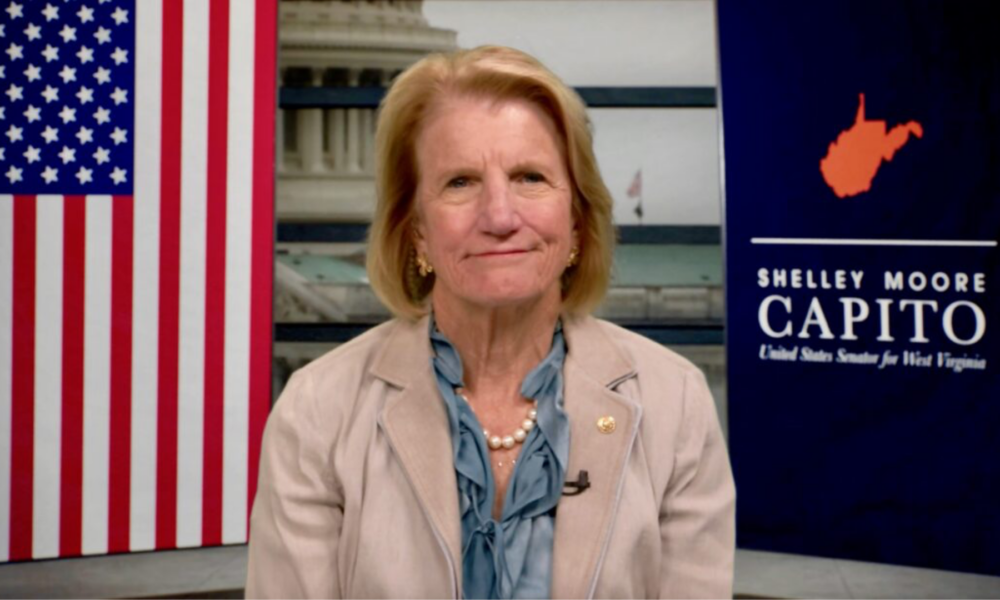
Charleston – U.S. Sen. Shelley Moore Capito said Thursday that she is still awaiting more details from a memorandum of understanding between President Donald Trump and Iran setting up a 60-day ceasefire, but she said the Senate should have final authority on any agreement.
Speaking to West Virginia reporters Thursday morning from Capitol Hill prior to floor votes, Capito said the Iran MOU should lessen the need for full-scale war and slowly begin to ease the strain at the gas pump. But a final agreement to end the war with Iran should be reviewed and approved by the Senate.
“I think it’s good news in that it’s a peaceful solution. It brings an end to the conflict,” said Capito, R-W.Va. “We haven’t been able to trust the Iranians to negotiate fully in truth, and I think I still have great skepticism as to whether, even with this memorandum of understanding, we can move forward. So, we’re going to have to have good oversight and good enforcement mechanisms. I think the president is obviously well aware of that and has talked about that.”
The official text of the 14-point MOU was released Thursday. The agreement establishes an immediate ceasefire and outlines a 60-day timeline to negotiate a permanent peace treaty.
Key provisions include the removal of naval blockades, the restoration of maritime traffic in the Strait of Hormuz and the termination of economic sanctions against Iran. In exchange, Iran commits to halting nuclear weapon development and allowing the International Atomic Energy Agency to oversee the down-blending of enriched materials.
“What I do know is that the ability for Iran to launch missiles and manufacture missiles used in their terrorist attacks has been severely diminished along with their navy,” Capito said. “I understand that this memorandum of understanding will open up the Strait of Hormuz. This should ease the gasoline issue of prices that we’ve seen, though they never come down as quick as they go up. I also think that it’s to be determined how effective this is going to be in terms of fully denuclearizing the Iranian republic, and those negotiations will continue.”
Additionally, the plan proposes a $300 billion reconstruction fund for Iran and the release of frozen assets to ensure regional stability
“My understanding is that these are frozen assets that are actually Iranian assets, that would then be unlocked if they stick to the agreement,” Capito said. “I still think this is a big sticking point.”
Other senators have expressed varying levels of concerns in other media outlets based on the released MOU text. Senate Armed Services Committee Chairman Roger Wicker, R-Miss., compared the MOU to the Joint Comprehensive Plan of Action negotiated with Iran by former President Barack Obama in 2015 in which Iran agreed to limit its nuclear program in exchange for sanctions relief and assets being unfrozen.
“Specifically, the $300 billion fund for the reconstruction and economic development of Iran – though not funded by taxpayers – would make Iran’s payoff under President Obama’s 2015 deal look like a pittance by comparison,” Wicker said. “President Trump has pursued peace through strength. I hope the intermediaries working on this deal are not undermining that objective.”
The final settlement will be solidified through a binding United Nations Security Council resolution. But Capito said any final deal between the White House and Iran should be voted on by the Senate.
“I think we need more details,” Capito said. “They may be still negotiating part of these, but we need to be a part of that. We’ve been left in the dark really this week, giving (Trump) some leeway to finish this up. But now that this has been signed, we need to have those details.
“If, in fact, the president does sign a full agreement with the Iranians, I believe it needs to come before the Senate for us to debate and for us to weigh in on,” she continued. “I demanded that when President Obama did the JCPOA in 2015. I think that President Trump should probably go in that direction so that he can have the advice and consent of the Senate.”
Read more from The Parkersburg News and Sentinel, here.