



By Mike Tony
For HDMedia
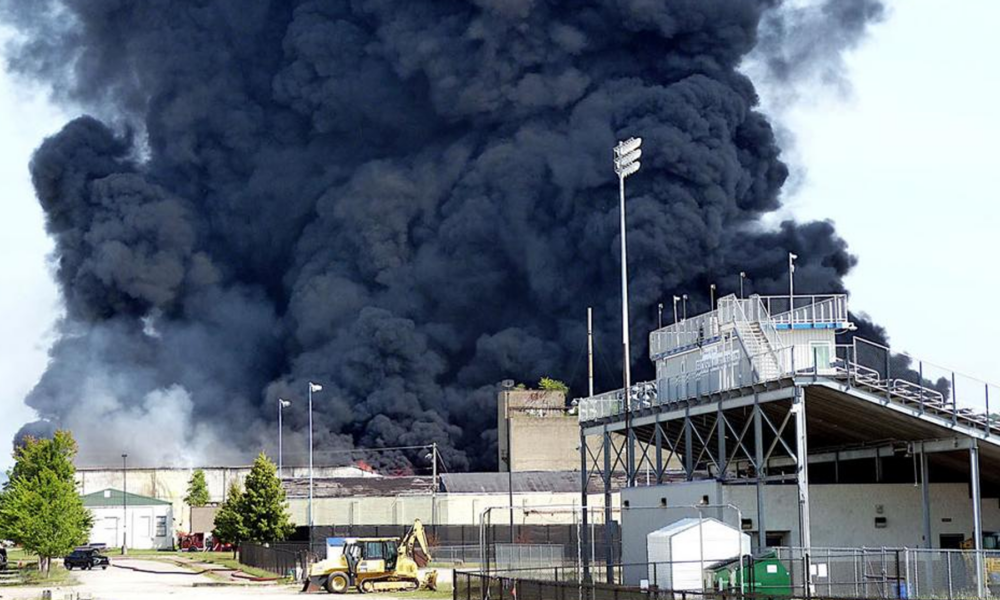
Officials’ answers have been greatly limited about the public health implications of a massive industrial fire that caused Gov. Patrick Morrisey to declare a State of Emergency Sunday afternoon as a thick plume of black smoke registering on weather radar emerged from warehouse provider Peoples Cartage’s site just outside Parkersburg.
While answers have been few, there have been many safety and environmental violations checkering the recent history of facilities operated by Peoples Cartage near Parkersburg and Kanawha County that loom large along with unanswered questions about acute and potential long-term health impacts from the fire, from which no injuries have been reported.
Firefighters still were battling the blaze Wednesday after it reignited on an enormous scale Sunday morning following initial containment Saturday.
The fire has triggered environmental health questions, with Wood County residents reporting black ash and debris from it in their yards and pools while contending with a nearly 24-hour shelter-in-place advisory issued by Wood County 911 from Monday to Tuesday afternoons for a roughly half-mile stretch of the Staunton Turnpike corridor along the Little Kanawha River that the agency attributed to “air monitoring particulate levels hav[ing] recently exceeded minimum threshold levels.”
Officials so far haven’t identified the chemical composition of the fire. As of Wednesday afternoon, Wood County 911 had not responded to a Gazette-Mail Freedom of Information Act request for a chemical inventory list called a Tier II Emergency and Hazardous Chemical Inventory form that may have existed for the facility along Camden Avenue just outside Parkersburg.
Peoples Cartage and Total Distribution have not provided chemical inventory information upon request from the Gazette-Mail. Instead, Shannon Whetsell, Peoples Cartage marketing director, on Tuesday directed the Gazette-Mail to a company statement in which Peoples Cartage said it was “assessing the damage” with environmental and safety officials “on-site to safeguard the health and safety of emergency responders and the community at large.”
Asked what chemicals were involved in the fire and emitted into the atmosphere, a spokesperson with the West Virginia Department of Environmental Protection also speaking for the United States Environmental Protection Agency said Tuesday evening “preliminary reports and information” indicated the facility mainly housed plastic and rubber pellets, thermoplastic resins and other similar materials. The spokesperson said the DEP and other responding agencies were “continuing to identify and catalogue materials stored at the facility.”
Wood County 911 director Dale McEwuen said at a meeting before the Wood County Commission Monday that he had spoken with the EPA regarding “questions about contaminants in pools, runoff in the river, ash on cars.”
“Right now, they can’t give us an answer on that, only because they have to do the investigation to find out what was in there,” McEwuen said.
The DEP spokesperson said Tuesday evening responding agencies were “working diligently to assess potential environmental and health impacts from this fire and ensure community and worker safety,’ with information and guidance to be released as it becomes available.
The DEP has initiated sampling in the Little Kanawha River to determine any potential impacts from runoff from firefighting activities, with preliminary laboratory testing not identifying results exceeding applicable water quality standards, the spokesperson said, adding that further. samples were being collected and certified laboratory testing underway to confirm the results and determine whether more action was needed.
The spokesperson said the DEP was coordinating with the Parkersburg Utility Board to assess whether stormwater containing accumulated ash could be accepted into the wastewater collection system for treatment. The DEP and the West Virginia Department of Agriculture were in communication regarding potential impacts to animals or vegetation, the spokesperson said.
The EPA was conducting air monitoring and modeling in the vicinity of the fire, according to the spokesperson.
EPA recommendations to the county regarding pools and ponds have included testing pool water to ensure chlorine levels and pH are within acceptable levels and draining and cleaning pools with a significant amount of ash, the spokesperson said.
Any debris in swimming ponds suspected of being impacted should be removed before use, the DEP spokesperson said, adding that aeration could speed the process of equilibrating ponds from any pH change due to ash fall over time.
Small amounts of ash in a pool, the spokesperson said, “may not be an issue.”
At a Tuesday afternoon news conference, Wood County Commissioner David Blair Crouch said county officials would work with the DEP to determine what remediation is needed for the site, which houses what Total Distribution’s website, totaldistribution.com, identifies in part as a 1.2 million-square foot warehouse for contract packaging, polymer milling and blending, and dry bulk packaging of resins and powders.
The fire has dredged up memories of an October 2017 fire at an International Export Import, Inc. plastics warehouse in Parkersburg that burned for eight-and-a-half days near the Little Kanawha River, causing a chemical plume that prompted air quality concerns and triggered school closures after a string of environmental violations and volunteer firefighters warning that the facility could be a major fire risk.
Crouch later said, living “in a chemical valley here with a lot of production, sort of like Kanawha County,” he had “resigned himself as a 60-year-old to be full of microplastics.”
“It’s the truth,” Crouch said.
Community air monitors at unhealthy levels day into blaze
The DEP spokesperson said the agency’s personnel responded Sunday morning and began conducting initial air monitoring using meters capable of detecting carbon monoxide, hydrogen sulfide, volatile organic compounds, oxygen levels and lower explosive limits. The DEP contacted EPA Region 3 shortly after 10 a.m. Sunday, roughly three hours after the agency was notified about the fire through the statewide spill line, to request additional air monitoring support, the spokesperson indicated.
EPA Region 3 arrived Sunday and coordinated with the DEP to deploy five monitors for smoke-related particulate matter and five monitors capable of detecting volatile organic compounds, carbon monoxide, hydrogen sulfide and hydrogen cyanide, the DEP spokesperson said.
The monitors initially were deployed at locations within approximately a half mile of the site based on conditions and the movement of the smoke plume, the spokesperson said, adding that further monitoring equipment was being deployed closer to the site to support first responder safety. Monitoring locations may be adjusted as conditions change and is expected to continue while substantial smoke impacts remain, the spokesperson said.
The only air monitoring site for Wood County listed in the DEP’s 2026 plan for its ambient air quality monitoring network is at Neale Elementary School in Vienna, more than 7 miles from the Peoples Cartage facility where the fire occurred.
Real-time community air quality monitoring results in the Parkersburg and Vienna areas published by PurpleAir, a company whose sensors track and collect localized air quality data throughout the U.S., showed a rise in levels of fine particulate matter, or soot, ranging from moderate to unhealthy for sensitive groups Sunday to unhealthy for the general public Monday.
By Wednesday morning, they had returned to the moderate level, still posing a risk for unusually sensitive people.
Soot has been linked to premature death in people with heart or lung disease, heart attacks, worsened asthma and diminished lung function.
The Federal Aviation Administration at 2:25 p.m. Tuesday issued a no-fly zone with a 1-nautical mile radius and 1,000-foot altitude for the Parkersburg area to last until 4 p.m. Thursday.
The DEP has collected water samples and deployed containment booms in the Little Kanawha River to assess and mitigate potential impacts from firefighting runoff, per the spokesperson, who noted the West Virginia State Fire Marshal’s Office was leading an investigation into the origin and cause of the fire.
As of Wednesday morning, the fire was contained, with Wood County 911 command post shutdown and scene release to the property owner slated for noon, according to a Wood County 911 official. Site cleanup by fire personnel is expected to last several more days, the official added.
Long string of past violations, ‘areas of concern’
Peoples Cartage facilities in Wood and Kanawha counties have a history of hazardous waste-reporting and handling violations issued by the DEP, and this weekend’s fire wasn’t the first at a site at a Parkersburg-area company site.
DEP records show a March 19, 2026, inspection at Peoples Cartage’s 221 Airport Industrial Park Road site further outside Parkersburg, about 11 miles from the site of this weekend’s fire, yielded agency-identified violations for not labeling some plastic containers in a storage area with the words “Hazardous Waste” or with their accumulation start date, and in another storage area, not marking 34 hazardous waste containers with the accumulation start date or an indication of the hazards they contained.
The inspection also flagged, as an “area of concern,” two accumulation areas with moisture collecting on the floor of the building — a concern since oxidizing and reactive materials should be in a cool and dry area without the pooling or presence of water runoff, an inspection document noted.
The inspection was conducted to test that Peoples Cartage was meeting a compliance schedule set in a DEP consent order that followed a June 2025 violation notice.
The DEP compliance schedule evaluation reported the facility had generated over 2,200 pounds of hazardous waste in a month, a violation since the company had failed to declare as a large hazardous waste generator exceeding that threshold rather than a small hazardous waste generator.
Peoples Cartage also failed to report two wastes, one generated by sodium dichlor and one from repackaging in-tank sanitizer and automatic toilet bowl cleaner Dantobrom TBS-2.5, both corrosive oxidizers, another violation, per DEP records.
In December 2025, the DEP issued a consent order for Peoples Cartage’s Airport Industrial Park facility fining the company $46,380 in response to federal and state code violations.
The order noted a July 28, 2020, inspection of that facility in response to a fire determined to have occurred under a canopy behind a building where hazardous waste calcium hypochlorite had been stored. Calcium hypochlorite is a lung irritant with a chlorine-like odor used in pool chemical products.
The waste calcium hypochlorite had been moved outside after a previous fire had occurred on July 4, 2020, inside a building storage area, yielding violations for failure to minimize the possibility of a fire and accurately determine its generator category based on the amount of hazardous waste generated in a calendar month. The DEP issued a violation to REO Processing West Virginia prior to Peoples Cartage’s acquisition of the site, according to DEP records.
On March 16, 2025, the DEP Spill Hotline received a report of a fire at the facility involving the combustion of calcium hypochlorite hazardous waste for which Total Distribution was responsible, according to the DEP. A next-day inspection uncovered violations that included:
- Storage of a container holding hazardous waste that was open when not in use
- Failure to mark or label its containers of hazardous waste with the date upon which each period of accumulation begins
- Failure to display the words “Hazardous Waste” on storage containers of hazardous waste
- Failure to dispose of hazardous waste without a permit
In May 2025, Peoples Cartage notified the EPA of the facility name change from REO Processing West Virginia to Peoples Cartage, seven months after Total Distribution’s acquisition of REO Processing was announced, per the DEP.
The DEP Spill Hotline on June 4, 2025, got a report of a fire at the facility involving the combustion of calcium hypochlorite hazardous waste, with the facility reporting an unknown amount of calcium hypochlorite had been released into the atmosphere due to a fire igniting in a storage building, according to DEP records.
The cause of the fire was attributed to a chemical reaction occurring in “floor sweep” buckets, with the facility relaying it didn’t know which contaminant of the “floor sweep” material had caused the chemical reaction and resulting fire, per agency records.
A next-day inspection uncovered violations that again included failure to minimize the possibility of a fire and disposal of hazardous waste without a permit, according to the DEP.
Peoples Cartage in September 2025 submitted a corrective action plan outlining action items following the violations, per DEP records.
‘Wash your vegetables’
An August 2023 DEP inspection of a chemical storage warehouse and distribution facility at 325 W. 19th St. in Nitro operated by Total Distribution doing business as Mitsubishi Chemical Group resulted in similar violations: storage of hazardous waste beyond 90 days without a permit and failure to properly label containers of hazardous waste.
Mitsubishi hazardous waste was being accumulated at the facility interspersed with material not considered waste, according to DEP records. Total Distribution personnel said Mitsubishi determined 80,000 pounds of material to be hazardous waste on Aug. 8, 2023, but was unsure which containers were the hazardous waste destined for disposal. TDI accordingly relayed the containers were not properly labeled with the words “Hazardous Waste” and weren’t marked with accumulation start dates, the DEP reported — a federal code violation.
There was no central accumulation area for hazardous waste, the DEP noted in an inspection report, flagging that setup as an area of concern.
The DEP spokesperson said Tuesday that it will inspect the Peoples Cartage facility where this weekend’s fire occurred once the fire is extinguished and the site is cleared for entry, with “appropriate enforcement action” to be taken if violations are identified.
The facility where this weekend’s fire took place is not required to have a DEP air quality permit, the spokesperson said, adding that the agency hadn’t identified records indicating previous fires at the facility.
The U.S. Chemical Safety and Hazard Investigation Board, an independent, nonregulatory federal agency that investigates and reports on the causes of major chemical incidents, did not respond Wednesday when asked whether it would investigate the fire.
Meanwhile, nearby residents are left living with the consequences.
James Leonard Anthony and Doris Jean Anthony of Parkersburg on Tuesday filed a federal class-action lawsuit against Peoples Cartage and Total Distribution alleging personal injury and property damages from the warehouse fire and resulting smoke.
Asked by the Gazette-Mail for comment on the complaint Wednesday following the publication’s unmet request for chemical inventory information, Whetsell said the companies would “provide additional updates as new information becomes available.”
The complaint cites aforementioned DEP violations since 2025 for the Airport Industrial Park facility to contend the companies showed “clear disregard to the apparent, obvious, and demonstrated fire risks inherent to their operations” prior to this weekend’s fire.
“This fire is another reminder that Mid-Ohio Valley communities continue to bear the cumulative burden of industrial pollution — from PFAS and GenX contamination to repeated industrial fires,” the West Virginia Rivers Coalition, a statewide water restoration nonprofit, said in a statement Monday, alluding to industrial chemicals with a history of toxic pollution throughout the region. “West Virginians deserve stronger oversight, better safeguards, and greater accountability to prevent these disasters before they happen.”
“Wash your vegetables before you eat them,” Crouch said at his Tuesday news conference.
Read more from HDMedia, here.