



By Autumn Shelton, West Virginia Press Association
CHARLESTON, W.Va. – Members of the legislative Agriculture and Rural Development Committee heard about priorities for the upcoming 2024 Farm Bill and discussed ongoing concerns surrounding the Kratom Consumer Protection Act during their interim meeting on Monday.
According to Lora Walker, general counsel for the West Virginia Department of Agriculture (WVDA), the 2024 Farm Bill will be similar to the 2023 Farm Bill (Senate Bill 581), which did not make it out of the House Judiciary Committee this past legislative session. However, it will include new items.
“We previously would introduce one big farm bill as our package of legislation every year,” Walker began, adding that this year the bill will be broken down into smaller bills.
She explained that items from the former bill to be readdressed include the transfer of approximately 250 acres, known as the Huntington State Hospital Institutional Farm, to the town of Barboursville in Cabell County as well as the transfer of WVDA-owned lots to the city of Ellenboro in Ritchie County.
Additionally, bills will address updated definitions on auctions and auctioneers, provide for an increase in the number of board review members, make a change in public hearing requirements for the West Virginia Noxious Weed Act, and restrict ownership of agricultural land holdings, Walker said.
One new bill to be addressed will focus on “Truth in Labeling.”
“This applies to certain products such as meat, eggs and other products,” Walker explained. “We want to make sure if it’s meat, it’s labeled as meat clearly, and if it’s not, it’s labeled as what it is. We see it as an important measure for consumer protection.”
Another new bill will include a custom slaughter tax exemption.
“The issue is simply this; when you go to an operation in West Virginia and you’re getting a custom slaughter piece done, they’re essentially being double taxed. It’s a sales tax and then a tax that applies to the slaughter as well. We are looking to cut that so we can encourage businesses in West Virginia to grow,” Walker said, adding that there is a huge need in the state for more meat processing facilities.
Walker then discussed the need for the legislature to budget $2 million for the West Virginia Grown program.
Information on West Virginia Grown, found on the WVDA website, states the program “was designed to market West Virginia grown and made products to consumers. By placing the West Virginia Grown logo on a product, they are assuring buyers that product was grown or processed, with quality ingredients, in the Mountain State.”
“This is a really great program that we’ve tried to keep self-sufficient, but it is growing so fast, which is amazing–that’s a good thing and we don’t want to stop that growth,” Walker said. “We have the capacity to keep it up for a little while, but we definitely want everyone to pay attention to that budget request this year. It’s in there every year.”
Walker said the state has approximately 300 West Virginia Grown vendors, from Christmas tree growers to candy and salsa makers.
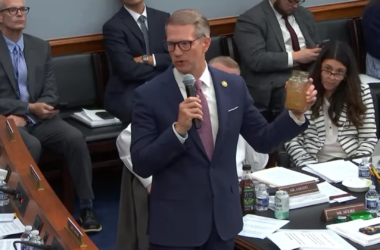
Following Walker’s update, Sen. Mike Stuart, R-Kanawha, discussed the Kratom Consumer Protection Act and asked for an update on its enforcement.
“You’ve been very helpful in the drafting and passage of Senate Bill 220 (the Kratom Consumer Protection Act) dealing with Kratom–Delta 8 and Delta 10,” Stuart said to Walker, noting that the bill went into effect on June 9, with enforcement authority placed under the WVDA along with the state’s Alcohol Beverage Control Administration (ABCA).
“My impression is, when I get texts and messages from moms and dads across West Virginia, is that the vape shop Delta 8, Delta 10 flashing syndrome is worse today than when we passed the bill,” Stuart said.
According to the United States Drug Enforcement Administration’s website, Kratom is “a tropical tree native to Southeast Asia. Consumption of its leaves produces both stimulant effects (in low doses) and sedative effects (in high doses), and can lead to psychotic symptoms, and psychological and physiological dependence.”
Walker responded that during a recent special session, they were trying to pass an amendment to increase the rule-making abilities of the ABCA. However, that amendment was not passed.
“What I can tell you is that these things take time, and I have been amazed with the speed that we are already moving,” Walker said.
“Until we get that amendment, which I believe will be pushed as a tax initiative this session, we can’t do as much on enforcement,” she continued, noting that their focus will be on creating regulatory rules with members of law enforcement and prosecuting attorneys.
“This is an issue that’s plaguing the country . . . we are first in the country to take action,” Walker noted.
Stuart continued, “I suspect that there is, in fact I know, there’s a whole bunch of product being sold out there that’s not even registered with the Department of Agriculture. How many folks do we have on the ground, or how many folks are you anticipating getting so that we can be more aggressive [with] our enforcement?”
Walker stated she couldn’t give an exact number because that depends on budgeting. However, she said that they are looking to hire more people.
“This is why the collaborative effort and approach is so important because I know for a fact that law enforcement feels overwhelmed too,” Walker continued. “These things pop up so quickly and come in so aggressively to our communities from out-of-state that it’s impossible for any one agency to keep up on its own.”
Sen. Jay Taylor, R-Taylor, added, “I’ve [received] complaints from constituents saying, ‘Hey, you told us these things were coming down this summer, but they’re still there.’ I get pictures sent to me [of] vape shops . . . advertising, basically, to the kids. Then, [I hear] reports of kids overdosing in the middle school bathrooms with this crap and it’s heartbreaking. Then, when I call the local police department, the confusion is really great.”
He asked if local law enforcement officers are able to shut down the stores, or make arrests.
“The amendment would allow the ABCA to come in and help us take things off the shelves,” Walker said. “It’s important to have both us, the ABCA and law enforcement all on the same page working together.”
“They still have the authority to arrest these folks based under the law,” Walker said of law enforcement officers. “If they have a question about the legality of something, please send it my way. But, as I said earlier, you just have to give us a little bit of time to get this going. It is a massive undertaking.”