

By Mike Tony
For HDMedia
Editor’s note: This report was supported by the Pulitzer Center and is part of a Gazette-Mail series on drinking water quality in West Virginia.
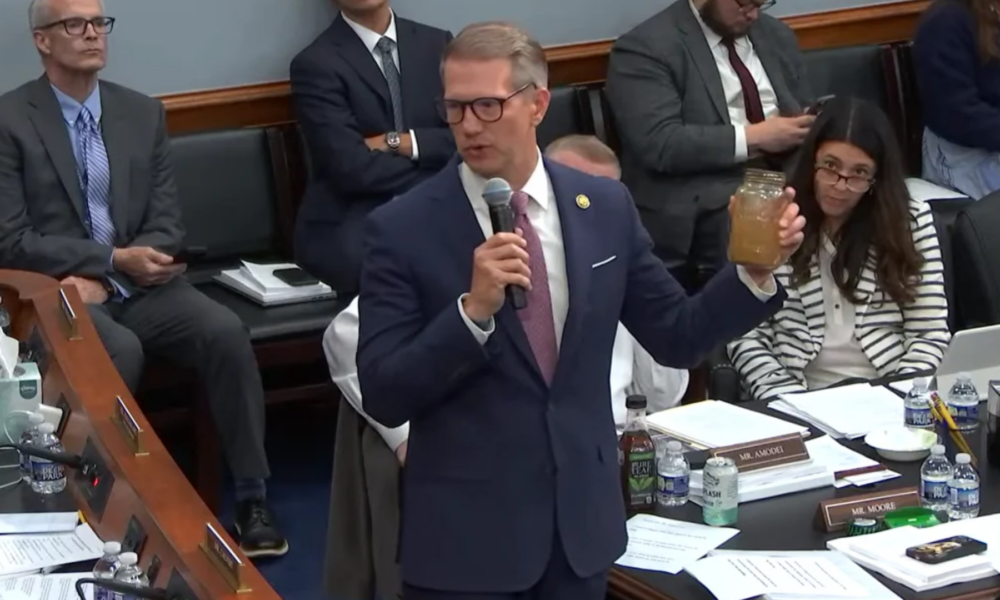
Standing before fellow U.S. House of Representatives members in a Washington, D.C. conference room, Rep. Riley Moore, R-W.Va., had his staffers distribute jars of auburn-colored water collected the prior week from homes in McDowell County long plagued by failing water infrastructure.
Wielding the microphone during a House Appropriations Committee meeting, panel member Moore reported one jar came from a McDowell County woman who collects water from a natural spring — which she gets to by traveling up and down a mountain via a mule — because she doesn’t trust the water flowing from her own faucet, which Moore said has left the woman with sores and chemical burns.
In the Rayburn House Office Building, Moore reported that, back in the tiny McDowell County community of Iaeger, there’s a woman who keeps an 1,800-gallon drum outside her home to catch rainwater, depending on others to haul water from a spring because she’s too old to carry it herself.
A man in the similarly small historical coal town of Bradshaw near the Tug Fork River, Moore said, opened a coffee shop, only to have his filtration system designed to last six months destroyed after only eight days due to excessive strain from poor water quality.
“They’re simply asking that we see them as fellow citizens,” Moore said. “Fellow Americans who deserve to be able to pour a clean glass of water for their children and for their grandchildren. Now we’re not going to solve all the drinking water problems in one appropriations bill. Certainly, that need’s too great. But this is a great place to start.”
That place, Moore was asserting during his June 3 speech before the House Appropriations Committee, was an amendment he was proposing to a Fiscal Year 2027 Interior, Environment and Related Agencies spending bill that would allocate $50 million in federal grant funding for drinking water and wastewater infrastructure, with the state of West Virginia providing a match of 25%.
At least $25 million would have been for projects within nine counties throughout the southern coalfields that have bore much of the heaviest burden of outdated water and wastewater infrastructure, suffering from dwindling populations and tax bases to draw from for long-overdue system upgrades.
Thousands of West Virginians have contended with discolored, foul-smelling drinking water from their faucets and wells. Those defects are driven frequently by exceedances in contaminants like iron and manganese that, although not thought to pose a human health risk, stain residents’ clothes, sinks and tubs — and isn’t considered potable by communities turning to expensive bottled or bacteriologically compromised roadside spring water instead.
Moore’s amendment would have required West Virginia to prioritize projects in counties with a poverty rate of 20% or higher or that address areas with high levels of federal Safe Drinking Water Act violations or water quality issues that have existed for more than 10 years.
West Virginia in 2024 had the country’s highest percentage of public water systems with health-based federal Safe Drinking Water Act violations — 29.2% — according to a Gazette-Mail analysis of U.S. Environmental Protection Agency data.
But the committee rejected Moore’s proposed amendment, led by House Interior, Environment and Related Agencies Appropriations Subcommittee Chairman Mike Simpson, R-Idaho, who said he “fully admit[ted]” water infrastructure needs in West Virginia and other areas but argued that the proposal wasn’t “properly vetted” by other panels that advance funding plans — like his.
Simpson’s subcommittee, though, already had advanced draft funding legislation that ignored a $250 million West Virginia southern coalfield water infrastructure funding request pushed by local and regional community advocates — prompting Moore’s proposal.
A leader of one of those advocacy groups, the Rev. Caitlin Ware, codirector of From Below: Rising Together for Coalfield Justice, noted afterward that Simpson had acknowledged West Virginia’s great drinking water upgrade need but blocked the proposal to address it anyway.
“It’s abandonment on full display,” Ware said, “and the blood is on their hands.”
Hundreds of millions sought for upgrades
Last month, representatives from Appalachian Voices, West Virginia Rivers Coalition and From Below traveled to Washington to educate members of Congress about the water crisis in West Virginia and back what had been a $250 million appropriations request from Moore and Rep. Carol Miller, R-W.Va., who represents southern coalfield counties but doesn’t sit on the Appropriations Committee like Moore.
The bill contains $8.3 million in Community Project Funding for 10 water and wastewater infrastructure projects requested by Miller, including projects in the nine-county area targeted by Moore’s amendment. Members may request Community Project Funding for state or local governmental agencies or eligible nonprofits.
But $8.3 million, not all of it going to southern coalfield counties, is just a drop in the bucket when it comes to West Virginia’s water and wastewater infrastructure needs.
The West Virginia Department of Environmental Protection has published a draft of a federally required plan for how to help public water systems finance the cost of infrastructure needed to comply with Safe Drinking Water Act requirements through the EPA-overseen, DEP-administered Drinking Water Treatment Revolving Fund.
That draft, up for public comment until June 30, lists state priorities for water and wastewater infrastructure improvement projects to draw from the state’s fund.
Projects for which Drinking Water Treatment Revolving Fund assistance are requested get prioritized using a ranking system consisting of five categories: public health, regulatory compliance, affordability, readiness to proceed and sustainability.
A DEP spokesperson said that an in-person and virtual hybrid meeting scheduled for 9:30 a.m. on June 17 at DEP headquarters in Charleston is intended mainly to inform potential applicants — local governments, public service districts and other eligible entities — and provide an opportunity for input on the programs.
The lists don’t constitute funding approval or a commitment of funds.
The highest-ranked up-to-five projects listed for each of the nine counties targeted by Moore’s defeated amendment — Boone, Fayette, Lincoln, Logan, McDowell, Mercer, Mingo, Raleigh and Wyoming — have a combined price tag of over $291.9 million, according to a Gazette-Mail review of the plan.
But less than 48% of that combined cost — roughly $139.1 million — would be covered by state revolving fund amounts slated for the projects via the plan, suggesting the local governments and public service districts seeking that funding must look elsewhere.
There are fewer than five projects listed for Boone (one) and Raleigh (three) counties.
And there are 222 projects listed in total, more evidence that the nine-figure funding gap for the southern coalfields’ projects ranked as having the greatest drinking water infrastructure needs only barely begins to capture the enormity of that need in the region and statewide.
A report prepared for the Appalachian Regional Commission and published last year suggested there could be a price tag on it by estimating West Virginia’s drinking water needs would cost roughly $1.73 billion when accounting for the state’s 414 community water systems.
That estimate doesn’t account for the thousands of West Virginians still relying on undocumented private wells or roadside springs thought to harbor greater health dangers because they don’t trust their own water supply throughout the state.
“This is not an abstract policy debate,” Maria Russo, policy specialist at the restoration nonprofit West Virginia Rivers Coalition, said in a statement after Moore’s amendment failed. “This is about people. It’s about families who have spent years worrying about what is in their water, communities struggling to afford solutions, and residents who simply want the assurance that their water is clean and safe.”
The DEP and state Water Development Authority, a separate entity that serves as a revenue bond bank to provide financing to local governmental agencies for water and wastewater facility construction, have faced criticism from southern coalfield allies that they haven’t adequately supported projects in their communities.
Water advocates have been waiting on the Senate to develop and advance its own appropriations plan. The House and Senate would have to come to agree on an appropriations package.
“It looks like if progress is to be made on West Virginia’s water crisis during this appropriations cycle, Sens. Shelley Moore Capito and Jim Justice will have to step up,” Quenton King, government affairs specialist with environmental nonprofit Appalachian Voices, said in a statement after Moore’s amendment failed. “It’s 2026; the wealthiest nation in the world should have clean water for all of its residents.”
But spokespeople for Capito, who chairs the Senate Environment and Public Works Committee, and Justice did not respond to requests for comment.
Panel advanced slashing state revolving funds for water
West Virginia drinking water advocates’ plea for federal funding support follows the failure of a nine-figure funding package in the state Legislature in its 2026 regular legislative session.
Advocates had called on the Republican-supermajority Legislature to draw $250 million from the state’s $1.44 billion Rainy Day Fund for approved, shovel-ready water improvement projects in the southern coalfields.
So 52 organizations and local leaders urged United States congressional leaders in a May 7 letter for $250 million to address the most pressing drinking water and wastewater infrastructure projects in West Virginia’s southern coalfield counties.
Instead, the GOP-controlled House Appropriations Committee advanced a spending bill reducing funding for the EPA by 20% and rejected an amendment proposed by Rep. Bonnie Watson Coleman, D-N.J., that would have preserved the federal Drinking Water and Clean Water State Revolving Funds to Fiscal Year 2026 levels by undoing committee-proposed cuts.
Watson Coleman referenced an EPA estimate that over $1 trillion would be needed nationwide for water infrastructure improvements over the next 20 years.
“If there is one thing that my colleagues across the aisle and I should agree on, it’s that we are in an affordability crisis,” Watson Coleman said in an address introducing her amendment proposal.
“All our states rely on revolving funds to help finance water infrastructure projects,” Rep. Rosa DeLauro, D-Conn., the panel’s top-ranking Democrat, said in a hearing room speech.
Simpson objected to Watson Coleman’s amendment proposal, objecting to it lacking a budget offset.
The committee advanced legislation that would slash capitalization grants for state revolving funds and performance partnership grants by roughly $683 million, or nearly 16%, from the federal Fiscal Year 2025 funding level.
Net available funding dwarfed by listed project needs
The DEP’s draft Intended Use Plan for its Drinking Water Treatment Revolving Fund, the federally required plan for how to help public water systems finance the cost of infrastructure needed to comply with Safe Drinking Water Act requirements through the EPA, projects that its net available Fiscal Year 2027 funds total just over $138.9 million — a tiny fraction of the costs of estimated for its 222 listed projects.
Projects listed in the highest-ranking 10 on the list include:
- A new treatment plant for the McDowell County Public Service District
- A Gauley River Public Service District water line replacement in Fayette County to address an undersized line along Route 39 that regularly leaks, breaks and causes customer service interruptions
- A connector line installation for the City of Glen Dale in Marshall County — Capito’s native city — to address high levels of cancer-linked contaminants known as PFAS (per and polyfluoroalkyl substances) in the water
“Every day without action is another day that people are left living with uncertainty and risk,” Russo said. “West Virginia deserves immediate action for our water infrastructure.”
Read more from HDMedia, here.