



By Steven Allen Adams, Parkersburg News and Sentinel
CHARLESTON – AI, the use of artificial intelligence and large language models, is becoming more commonplace in everyday life and the workplace, including in how news is produced and consumed. And while a valuable tool, AI can also create its own issues in news gathering.
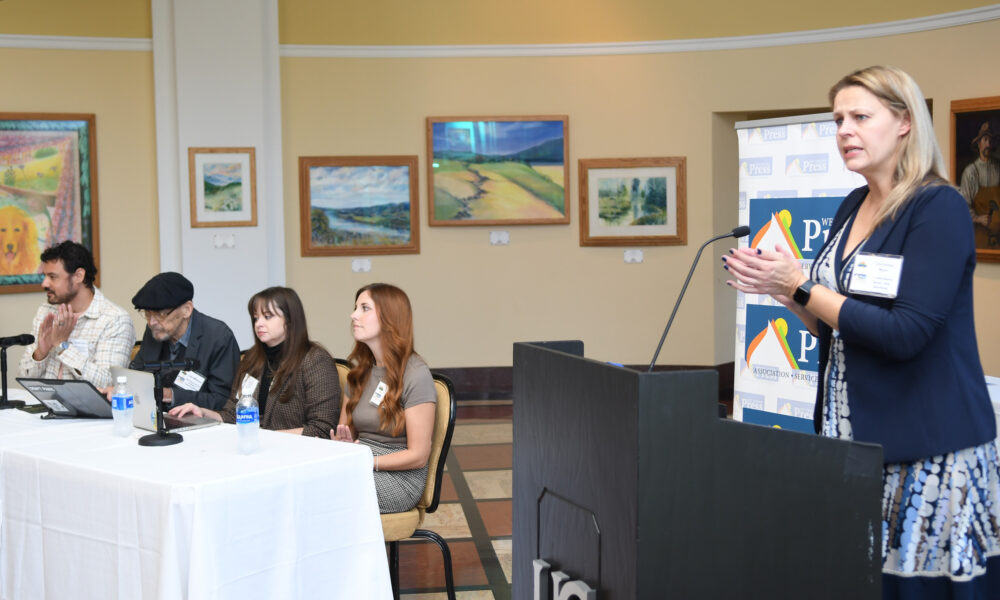
Attendees of Saturday’s West Virginia Press Association 2025 Annual Convention at the University of Charleston listened to a panel discussion on the impact of AI on journalism from experts from West Virginia University and from an award-winning investigative journalist, in a session sponsored by Appalachian Power.
Panelists were Joseph Jones, assistant professor of journalism at West Virginia University’s Reed School of Media and Communications; Joel Williamson Beeson, a professor emeritus of journalism at WVU; Ashton Marra, a teaching associate professor of journalism at WVU; and Amelia Ferrell Knisely, investigative reporter for West Virginia Watch, a non-profit news organization part of States Newsroom.

According to Jones, AI has become a blanket term that sometimes encompasses common tools used by most everyone – spell check in word processing programs, internet search engines based on algorithms, etc. But in recent years, AI has come to include large language model (LLM) programs and generative AI used for nearly everything, from transcription to making deep-fake videos and images.
“As publishers and journalists beholden to truth, we must recognize the hype, understand how AI works, and temper our expectations of what it can do,” Jones said. “So, the term ‘artificial intelligence’ is misleading. It’s not actually intelligent, and potentially, it causes us to overestimate what it is actually capable of. Essentially, we built machines that display human-like behaviors, but we can’t kick this habit of thinking that there is some human-like mind behind it.”
Jones said it was important for editors and newsrooms to take stock of what their needs are and whether AI programs are good tools to use.
“Instead of seeing an overhyped technology and asking how we can use it, I think it’s better to ask, what are we doing and what do we actually need,” Jones said. “We could thus ask, what is journalism for? What is its purpose? What needs do we actually have to serve that purpose? What is the proper role of automation in serving this purpose?”
Last winter and spring, Marra taught a class on experimental journalism, where her students used various free AI tools to analyze the 2025 regular session of the West Virginia Legislature, then compared the work of the AI programs to the reporting by several statehouse reporters to check the accuracy and effectiveness of the AI programs.
While the free AI programs did a good job in taking transcripts or draft legislation and summarizing the information fed into it, the programs were not able to emulate the emotional depth, the context, or the ethical standards that a human news reporter brings to their stories.
“What (the students) found is that each of these journalists have individual voices, but they also have context outside of what’s happening within that room – what’s happening in our communities, what’s happening in previous debates, what’s happening culturally in conversations around these issues that the AI just can’t do. It can’t replicate that,” Marra said.
“There were many times where (AI) was just pulling up and generating incorrect facts and misinterpreting things that were in front of it. The style and tone was not really fun to read,” Marra continued.
Marra said reporters, editors and newsrooms need to consider privacy issues when feeding interviews and transcripts into an AI program and understand how AI programs use that information.
“There are things that our sources will tell us as journalists and they trust you to protect that information,” Marra said. “The (AI) platforms do not readily disclose what information you’re sharing and how that information is being used.”
Knisely said her use of AI is relatively limited. States Newsroom has an AI policy for its affiliates, such as West Virginia Watch. But during the recent legislative session, Knisely used AI to help her understand the differences in legislation as it was constantly amended during the course of the 60-day legislative session. She also used it to analyze changes in budget line items in appropriations bills.
“I awkwardly put in a House version of a bill and a Senate version and took me a couple times to get the prompt right, but I asked ‘can you just compare these and tell me what’s different?’ So, that was kind of my starting point,” Knisely said. “That sounds really simple, but it actually was a huge timesaver for me. And it kind of went from there.”
While using AI to compare legislation, Knisely said she avoided using AI to provide input on how to write certain stories, craft headlines, or edit stories.
“I’m limited in how I can use it, but also I’ve made the decision personally that I don’t want AI to touch anything that I’m writing,” Knisely said. “I don’t want to use it to write headlines. I don’t want to use it to clarify things to write…because that just feels out of bounds for me as a journalist. I don’t want to ever have to put a disclaimer on my story that AI was used to write something.”
Beeson, a journalist with more than 35 years of experience in the field, said he was once optimistic about the use of digital tools for journalism and storytelling. But he said ethical considerations as AI use has grown have made him rethink earlier positions.
“I have researched, documented and witnessed the trajectory of the digital media ecosystem with great hope to build a more vibrant public information sphere online,” Beeson said. “Instead, this work has made me highly skeptical – which is probably an understatement – of claims that the latest technology will set us free from mundane, repetitive and soul-draining labor to focus on what really matters.”
The use of AI has created the ballooning need for data centers which have massive electricity needs. These data centers sometimes take up acres of land, requiring large amounts of water for cooling servers and equipment. Some data centers are using microgrids to generate the electricity they need on site, creating air pollution. The West Virginia Department of Environmental Protection recently approved two air permits for data center/microgrid projects in Tucker and Mingo counties.

Beeson said newsrooms should consider all of the implications of the use of AI, including the growth of the data center industry, the environmental effects
“I think there’s a mandate for editors and reporters to have a deeper understanding of the full sort of cross-sector implications of the AI revolution, and I don’t think we all really grasp the enormity of this at this point,” Beeson said. “You have to think of it akin to the industrial Revolution. And that puts a lot of strain on these newsrooms to effectively cover these issues, such as the rapid rise of data centers, microgrid power generation, and radical transformation of our landscape and of our infrastructure.”
https://www.newsandsentinel.com
See the Bots to Bylines slide deck below: