

By Craig Howell, The Weirton Daily Times
CHARLESTON – The art of advertising has changed dramatically throughout the centuries, but probably not as much as within the last 100 years.
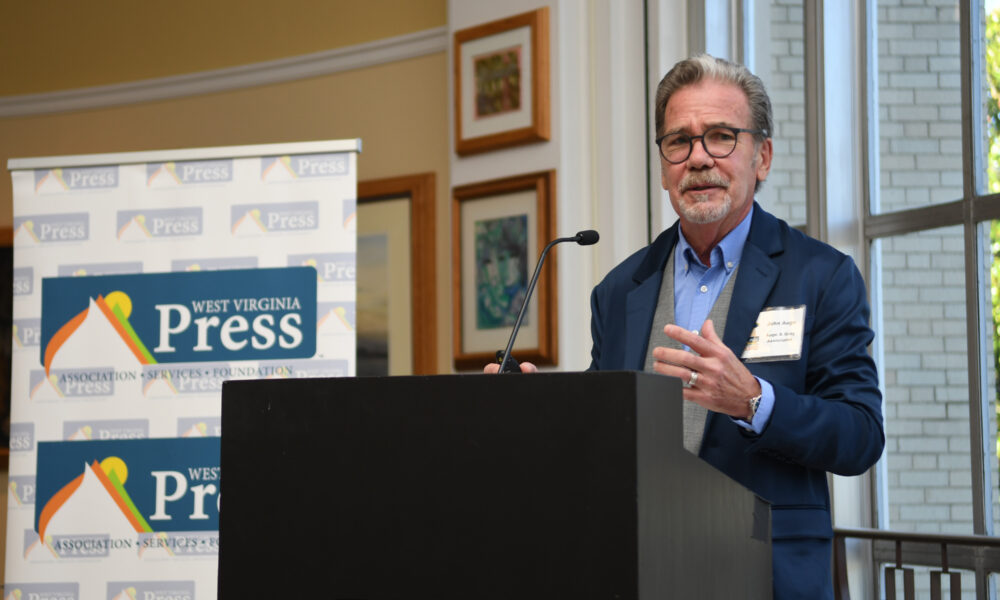
Attendees of the West Virginia Press Association’s 2025 annual conference, held Oct. 11 at the University of Charleston learned more about where advertising has been, and where it could go, through an educational session dubbed “The Evolution of Advertising: From Hieroglyphics to Algorithms,” sponsored by WVU Strategic Communications and Marketing.

The session was moderated by Linda Arnold, founder and former chair and CEO of The Arnold Agency.
“Advertising is both an art and a science,” she said, explaining the balance of intuition, creativity and understanding of the numbers game and markets needed to make it a success.
To underscore her point, Arnold incorporated some audience participation, asking those in attendance to complete portions of popular marketing slogans and handing out prizes to those who guessed them. She also raised some failures, such as issues with sales in Spanish-speaking countries for the Chevy Nova automobile and Coca-Cola in China, as a result of language translations, and the “Nothing sucks like ElectroLux” for the company’s vacuum products.

Steve Morrison, former general manager of Asher Agency’s Charleston office, revealed some of the earliest known advertisements can be traced to Egypt in 3000 BC, on graffiti and papyrus scrolls, evolving to actual signage by 500 BC in Rome and Greece.
The use of town criers have played a role in advertising over the centuries.
Advertising took a huge step forward with the creation of the Gutenberg press in 1440, allowing for mass duplication of printed materials, with the use of newspaper advertising beginning in the early 1700s in America.
The first advertising agency was formed in 1841, which eventually led to the development of brand building through the consistent use of recognizable slogans and logos.
“It continues to evolve today at breakneck speed,” Morrison noted.

John Auge, partner and creative director of Auge+Gray+Drake Collective Works, explained the importance of those images and messages in selling to the masses, as well as celebrity endorsements such as Loretta Lynn appearing in Crisco campaigns and the use of the character Snoopy by MetLife.
Incorporating popular music raised the bar even more, capturing the attention of the populace.
“I grew up soaking in those commercials,” he said.

With the rise of the digital age, advertising has now made its way on to the Internet, with ads being found through search engines, social media, and various other online platforms, explained Christina Myer, executive editor of the Parkersburg News and Sentinel.
Through artificial intelligence, advertisers now have an opportunity to save time and manpower, while also directing their promotions to specific audiences.
The use of influencer marketing has allowed companies to use both celebrities and digital-age personalities to reach widespread audiences at potentially lower costs.
“It’s product placement but it’s a bolder version,” Myer said.

AI comes with dangers, though, as Myer warned of the greater potential for manipulated images and information.
With a theme of “Past, Present and Future in Print,” the WVPA Conference also was sponsored by the Health Plan, the West Virginia School of Osteopathic Medicine, AARP West Virginia, Game Changer, Vandalia Health, Highmark West Virginia, West Virginia Department of Tourism, Appalachian Power, West Virginia Coal Association, Contractors Association of West Virginia, and the West Virginia Press Foundation.