



By Mike Tony
For HDMedia
An energy expert sensed artificial intelligence bubble trouble at a West Virginia Public Service Commission hearing the body held in Charleston last week on a proposal by FirstEnergy to build a $2.47 billion, 1,200-megawatt gas plant in Monongalia County supported by a new 2.3% annual rate hike, driven by the company’s anticipation of a 1,012-megawatt data center project yet to finalize a construction contract with the utility.
“If [utilities] can’t get the tenants that they think they’re going to be able to get or the tenants go bankrupt, I think there’s a tremendous amount of uncertainty, given the amount of investment that’s pouring into the sector right now,” Cathy Kunkel, a consultant with the Institute for Energy Economics and Financial Analysis, a Valley City, Ohio-based energy market analysis firm, testified. “I really question whether that’s going to be sustainable over the long term, so I do think we are we run the rest of being in an AI bubble, so to speak, and that we could end up with a lot of surplus data center capacity and potentially electrical infrastructure capacity that ends up being stranded.”
Kunkel was testifying as a witness for the West Virginia Citizen Action Group, Solar United Neighbors, and Energy Efficiency West Virginia, intervening as one party in the FirstEnergy case.
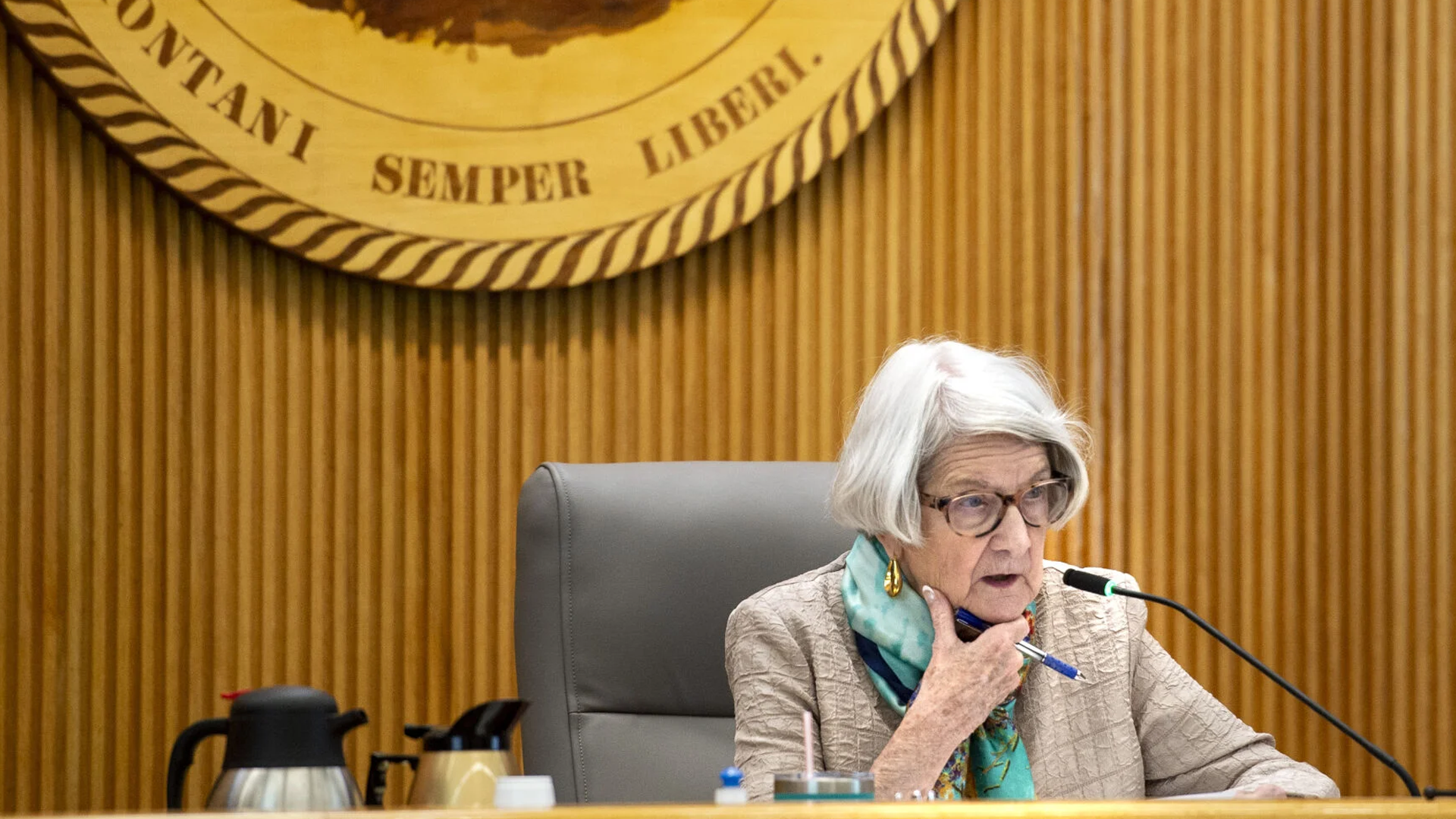
But PSC Chairman Charlotte Lane, the commissioner who had asked Kunkel what she thought of what the chairman called the data center “phenomenon,” already had formed her own opinion on how West Virginia’s energy landscape should proceed regarding data centers. In a February 2025 column published on the PSC’s website, Lane wrote the PSC was “doing its bit to keep those centers in operation by ensuring a constant and reliable source of energy through the burning of coal.”
Just a month later, the West Virginia Legislature green-lit more of that “bit” by passing House Bill 2014, legislation that has drawn the ire of community residents and advocates throughout the state by removing local zoning and other regulatory control over data center projects and shielding developers from having to share critical information about their projects publicly.
But HB 2014 went further.
The law requires utilities to maintain their generating units to be able to self-generate power and achieve at least a 69% capacity factor — a measure of how often a plant runs at full capacity.
Although a 69% capacity factor isn’t required if doing so would increase electric charges above an established rate, energy experts, ratepayer allies and even Appalachian Power representatives have said a 69% capacity factor target set by the PSC for West Virginia’s coal-fired plants in recent years has encouraged uneconomic use of the plants that cost utility customers.
The PSC’s Consumer Advocate Division, an independent arm of the agency charged with representing residential ratepayers, provided evidence suggesting that use has been uneconomic in a July 2 case filing.
The filing authored by Consumer Advocate Division witness and coal procurement expert Emily Medine, consultant with Energy Ventures Analysis, Inc., showed precipitous drops below a 69% capacity factor among the three coal-fired power plants controlled by American Electric Power.
AEP subsidiary Appalachian Power’s John E. Amos and Mountaineer coal-fired plants dropped in capacity factors from 51% and 73% in 2012 to 37% and 41% in 2024, respectively, while the Wheeling Power-co-operated Mitchell plant capacity factor tumbled from 59% to 30%.
Medine found Appalachian Power and Wheeling Power coal stockpile inventory levels “particularly concerning” since they come close to physical capacity limits noted in the companies’ testimony.
West Virginia has been an outlier in its enduring reliance on coal-fired power as other states shift to lower-cost renewable and gas resources.
Kunkel testified in another case last year that Appalachian Power and Wheeling Power incurred more than $150 million of operating losses over a two-year period from uneconomic operation of their coal units, entering into new coal contracts despite already high coal inventories.
Ratepayer advocates in the FirstEnergy gas plant case have urged adoption of a company large load tariff, a tool which may include special contracts, rates and service pacts between utilities and large-demand customers.
RMI, a Colorado-based clean energy consulting firm, has called for such tariffs to include ratepayer protections to reduce risk to customers if demand fails to materialize or come online more rapidly than expected, through contract minimums, term lengths, collateral, demand ramps, exit fees and other measures.
But FirstEnergy has rejected the calls for a large load tariff, instead proposing a special contract-by-special contract approach to data center developers that Christian Beam, president of FirstEnergy’s West Virginia and Maryland operations, testified last week argued was better than what he called a “one-size-fits-all” approach.
New Jersey Gov. Mikie Sherrill, a Democrat, this month signed into law legislation that requires utilities to file large load tariffs mandating that customers of 50 megawatts or more provide ratepayer protections sought by the state Board of Public Utilities, with tariffs required to incentivize data centers to develop and use methods to increase energy efficiency and guard against public customers “paying stranded costs.”
New York Gov. Kathy Hochul, another Democrat, this month issued an executive order imposing a one-year moratorium on new large-scale data center development.
‘We were the guys that basically wrote the bill’
But West Virginia has aimed to usher in data center development through HB 2014, which was requested by Gov. Patrick Morrisey, a Republican.
HB 2014’s wipeout of local say in approval of data center projects has drawn criticism from community advocates from throughout the state, but especially in Tucker County, where residents have widely opposed a data center complex project planned by Purcellville, Virginia-based Fundamental Data.
Fundamental Data representatives have been quiet about their plans for the data center complex project, which local leaders said took them by surprise upon the company’s March 2025 application to the West Virginia Department of Environmental Protection for an air quality permit the DEP granted five months later.
But belying Fundamental Data’s image among project critics as a distressingly mysterious outsider in an even more potentially troubling light this month was an appearance by self-identified company engineer Ted McGavran at a City of Belmont, North Carolina, Council meeting.
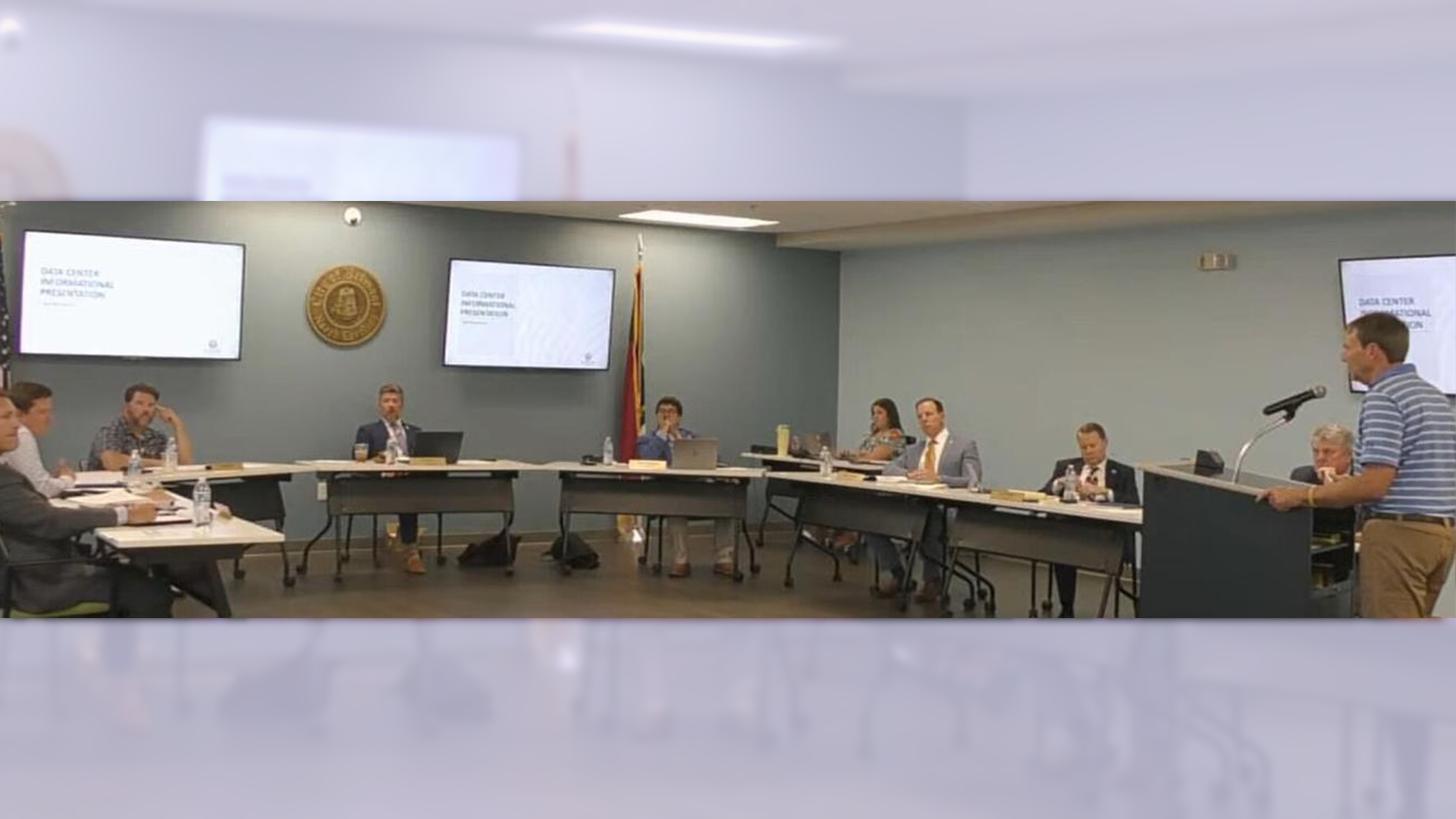
At the July 6 meeting, McGavran gave his perspective on “this data center world” to aid officials bracing for data center development in or around Belmont, where he lives, according to his Facebook page.
“We were the guys that basically wrote the bill and got it through the Legislature in 2024 and early 2025,” McGavran said of HB 2014, which he said allows the company to “set out the rules for what’s called a microgrid,” adding that “it’s really a macrogrid, as big as it’s going to be.”
A microgrid is a localized power grid that can operate independently to produce electricity.
HB 2014 prohibits counties and municipalities from enforcing or adopting ordinances, rules or regulations that limit creation, development or operation of any certified microgrid district or “high-impact” data center project, a category for projects to house and operate data-processing equipment that have a power capacity of at least 90 megawatts for their computing equipment.
HB 2014 eliminated a requirement that electrical service to business development districts be generated from renewable sources and removed a limit on such districts from a 2022 law designed to facilitate development of microgrids. The 2022 law, Senate Bill 4001, established a Department (now Division) of Economic Development-administered program that permitted exemption from PSC requirements for provision of renewable energy within “high impact” industrial business development districts.
“We can do pretty much whatever we want to do up there,” McGavran told the Belmont council. “We’re not under the utilities commission.”
‘We’re also going to need security’
McGavran described the project as being located in the “middle of nowhere” in Tucker and Grant counties.
A June 18 letter from Department of Commerce Deputy Secretary Nicholas Preservati reported that at a May 18 meeting he said was held at Blackwater Falls State Park in Tucker County, Fundamental Data revealed that:
- The project will include a microgrid and data center.
- The gas-fired power plant for which Fundamental Data submitted an air quality permit application to the DEP is part of the microgrid and data center project.
- The gas-fired power plant would be located in Tucker County and the data center facilities would be located in Tucker and Grant counties.
- Fundamental Data “owns, operates, or otherwise controls” the property to be used for the project.
- The first phase of the project would include roughly 800 megawatts of power generated from natural gas, 1.3 gigawatts of electricity generated from solar, and 14 data center buildings that will use over 2 gigawatts of power.
- The second phase of the project would include an additional 3.1 gigawatts of gas-fired generation and a sufficient number of data center buildings to use that amount of generation.
Those figures would make the project, called the Ridgeline project, one of West Virginia’s largest industrial complexes.
McGavran recommended Belmont council members consider a “noise ordinance” for data centers, citing the potential for noise pollution from backup diesel generators.
Fundamental Data’s planned Tucker County facility would be powered by gas-fueled turbines equipped with heat recovery steam generators, but the turbines may need to use diesel as a backup fuel source during gas pipeline failures, according to DEP records. The facility, planned for a location off U.S. 48 near the city of Thomas, would have three diesel storage tanks that could hold 10 million gallons each. The company’s air quality permit application indicated there would be haul road activities and equipment leaks.
In January, a Tucker United-commissioned report via the Harvard T.H. Chan School of Public Health’s Dominici Lab was released estimating Fundamental Data’s planned operation could inflict up to $35 million in health-related damages.
McGavran told Belmont council members data center developers should be made to pay for “any infrastructure updates,” which he said would typically apply to “the water [and] sewer situation.”
Large data centers can consume 3-5 million gallons of water per day — roughly 5%-8% of the total amount withdrawn for public water supply throughout West Virginia in 2023, according to DEP data.
“One thing I better say is we’re also going to need security. You may have to hire some extra security or something like that,” McGavran said, adding that data centers “can be targets for people that don’t like us.”
Nikki Forrester, spokesperson for Tucker United, an advocacy group of Tucker County residents who have opposed the project through public protests and pending legal challenges, responded to McGavran’s remarks in an email Sunday by saying Fundamental Data doesn’t “care about our home or our community.”
“They see Tucker County and the surrounding areas as a place where, with limited government oversight, they can make the rules and do whatever they want to turn a profit,” Forrester said. “The Ridgeline project is a pure money grab and the representatives of Fundamental Data have made it quite clear that they have no concern for us or the future we want to build in this special region of West Virginia.”
A Fundamental Data representative and a company spokesperson did not respond to a request for comment.
W.Va. leaders distance themselves from Fundamental Data
Morrisey’s personal X account on Thursday responded to a Fundamental Data-focused report by online news outlet West Virginia Watch by calling McGavran a “so-called representative” who “should be ashamed of himself.”
“No respectable company would allow someone who represents them to mislead the media and the public like this,” Morrisey’s X account said. “I’ve been worried about how this company has handled itself from the beginning. They need to do much better. Shame on them.”
Lars Dalseide, Morrisey’s office spokesperson, told the Gazette-Mail in an email Tuesday that HB 2014 was Morrisey’s bill and that its drafting was “deliberately limited to the Governor’s office to ensure the legislation reflected Governor Morrisey’s vision and priorities.”
“While we can’t speak to Fundamental’s interactions with legislators once the bill was introduced, HB 2014 was shepherded through the legislative process by the Governor and his staff,” Dalseide said.
The Morrisey administration this month rescinded a June 18 violation notice it issued to Fundamental Data that had set a deadline for the company to apply for state certification required for high-impact data center and microgrid projects.
A recission letter signed by Preservati accepted Fundamental Data’s assertion that the project is “still in the conceptual phase” and that there was a possibility that the power and data components of the project that has been expected to span Tucker and Grant counties won’t implicate HB 2014.
Declining to comment on McGavran’s remarks, Preservati told the Gazette-Mail Thursday that Fundamental Data had not submitted any application or additional documentation indicating that the project was anything other than still conceptual.
West Virginia House of Delegates Speaker Roger Hanshaw, R-Clay, and Senate President Randy Smith, R-Preston, whose district covers the project area and has denied knowledge of the project prior to the air quality permit application that followed passage of HB 2014, did not respond to requests for comment.
Hanshaw, as an energy regulatory attorney with Charleston-based law firm Bowles Rice LLP, has drawn criticism that he has harbored conflicts of interest by representing Fundamental Data against challenges of DEP air quality permits for Fundamental Data and another data center-linked project in Mason County.
Ann Ali, House of Delegates deputy chief of staff and communications director, said Tuesday HB 2014 sponsors Clay Riley, R-Harrison, Bob Fehrenbacher, R-Wood, and J.B. Akers, R-Kanawha, and House Energy and Public Works Committee staff had no knowledge of anyone from Fundamental Data being involved in the creation of HB 2014.
Fellow cosponsor Mark Zatezalo, R-Hancock, vice chair of the Energy and Public Works Committee from which HB 2014 advanced, said Fundamental Data had no involvement with the House or its work on HB 2014, Ali said.
Minority Leader Sean Hornbuckle, D-Cabell, wasn’t involved in the bill process but is listed as a sponsor because it was a bill requested by the governor, a designation that automatically lists the speaker and minority leader as sponsors, Ali said.
‘Should be alarming to everyone’
But while West Virginia leaders move to distance themselves from Fundamental Data, state residents are finding it harder to distance themselves from looming data center impacts to their power bills — and their power over their backyards.
At a Tucker County Commission meeting Wednesday, area advocate Natalie Boyland presented results from a questionnaire distributed to longtime locals indicating staunch opposition to the Ridgeline proposal.
Local coffee shop owner Carrie Archuleta told the commission her son is a sixth-generation Tucker Countian who has grown up swimming and fishing in local rivers and streams like she did.
Archuleta said she feared the project threatens to degrade local natural resources and push electricity costs upward.
“The lack of transparency from Fundamental Data and the state,” Archuleta said, “should be alarming to everyone.”
Read more from HDMedia, here.