



By Esteban Fernandez
For Times West Virginian
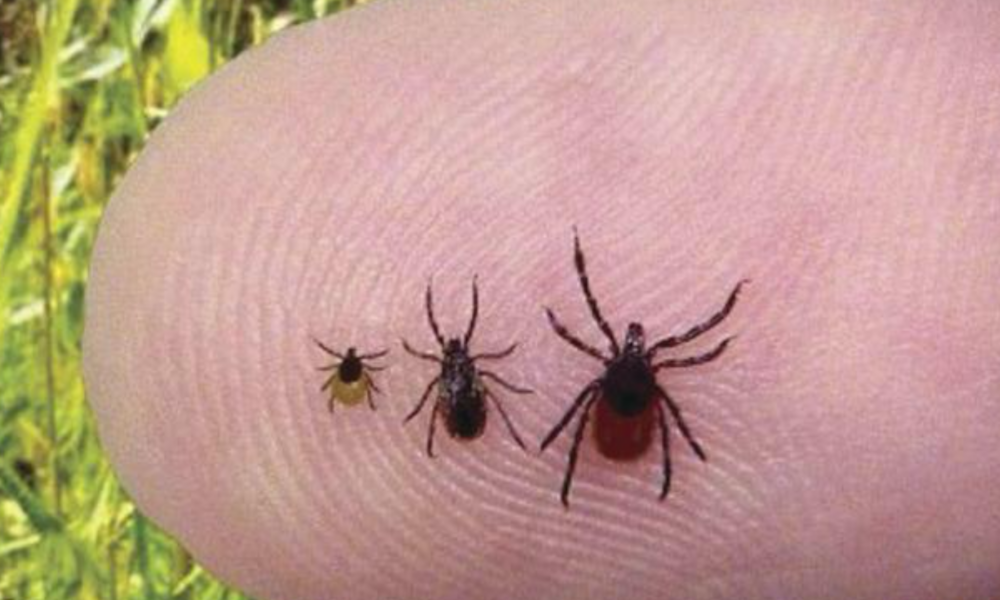
Fairmont — Experts are on the look out for a menacing creature this year — the tick.
“We don’t actually count tick populations, so it’s hard to give you any empirical data on that, but from what I’m reading, it seems to be increasing in the region,” Tim Driscoll, associate professor in the West Virginia University Department of Biology, said.
County Health Departments for the last few weeks have been warning about the prevalence of ticks in the Mountain State. The US Center for Disease Control and Prevention noted emergency room visits for tick bites have surged this year. West Virginia Lyme disease cases have quadrupled from 1,000 per year in 2020 to 4,000 last year. Cases are on track to exceed 4,000 this year.
That news horrifies Rivesville resident Barbara Hood who has a phobia of the creatures. A heavier tick season concerns her because she lives by two large meadows where the insects could be lurking. She has cats, and although they’re indoor pets, they occasionally slip out to where the parasites lurk. Hood remembers her neighbor catching Lyme disease about four years ago.
“I hadn’t seen him in a while, and I was driving home and he came over to my car to say hi,” she said. “I didn’t even recognize him, because he had Lyme disease. He looked so haggard and worn, I think he spent a weak in the hospital.”
Dr. Brian Huggins, chief health officer at the Monongalia County Health Department, said ticks are vectors for many different kinds of disease, not just Lyme disease. Ticks also carry anaplasmosis, babesiosis, Rocky Mountain spotted fever and the dreaded alpha-gal syndrome. Alpha-gal causes those infected to develop a red meat allergy, a true bane during grilling season. Huggins said there’s been a rise in cases on Anaplasmosis in the region.
Kanawha and Fayette counties have begun to offer doxycycline as a post-exposure prophylaxis, in case a patient experiences a tick bite. Huggins said providing that in Monongalia is something the health department is working on as well.
“For the average person, trying to get that treatment can be a little bit challenging,” he said. “Because you have to call your provider, try to get the medication and you’re trying to do all that within 72 hours, because within 72 hours of removing the tick, you’re supposed to start the doxycycline.”
Mon County is in the middle of a study to determine the size of their tick population. He said paradoxically, there’s fewer black legged ticks which are established in West Virginia and are vectors for Lyme disease. He said their observations go against what people are reporting anecdotally, so the real question is, which tick is experiencing population growth?
Driscoll said one possible explanation is northward migration of the Lone Star tick. It’s expanding its range into southern and central West Virginia. The Lone Star tick is associated with alpha-gal syndrome. Huggins said those haven’t been seen in North Central West Virginia — yet. Huggins said more generally, tick populations have been rapidly increasing. Climate change may be partially responsible. Warmer days through the winter makes it easier for them to survive the colder months.
What areas should be avoided? Driscoll said ticks spend a lot of time in leaf litter, where their preferred hosts, rodents, are. They also climb up blades of grass where they can catch a ride on larger animals. Driscoll said ticks serve as population control for rodents.
“Five to 10 adults ticks are enough to essentially exsanguinate a small rodent, they just feed on so much of the blood that the rodent dies,” Driscoll said. “You can see this with larger animals. If you have very large tick populations, they can take down animals as large as moose or even cattle.”
Huggins said one popular remedy for removing ticks is out of date. Popular wisdom goes that to remove a tick, one must expose a needle or paperclip to flame and then shove the hot end against a tick’s head. The logic goes, that makes it release the host. Huggins said that’s a mistake.
“What it actually does is, it does back its head out, but it ends up vomiting the contents of its mouth up first, because it’s undergoing trauma,” Huggins said. “So whatever was in its stomach, you now just have increased the risk of Lyme or Rocky Mountain Spotted Fever.”
Marion County Humane Society Director Jonna Spatafore also made sure to not leave the pets out of the conversation. They too need to be protected. She said tick prevention can be bought over the counter and applied once every four weeks for best results. She said to avoid cheap remedies, and that cats should not have anything that contains organophosphate.
Preventing ticks is important because pets can die from Lyme or other tick borne diseases, she said, or spend their lives in excruciating pain after a bite. Ticks can also get into the house and onto humans through pets as well. Spatafore said they’re having the land around the Humane Society treated for ticks. It’s the first time they’ve had to do it.
“The ticks were so bad, we would let the dogs out and they would come in and just be crawling all over their face and stuff,” she said.
Read more from Times West Virginian, here.