

By Mike Tony
For HDMedia
Hundreds of permit exceedances and unpermitted discharges of toxic water contaminants.
A multigenerational legacy of industrial water pollution near and into the Ohio River, a source of drinking water for some 5 million people — and people experiencing increased rates of cancer, thyroid disease and other health burdens.
A citizens’ lawsuit filed by water restoration advocates flagging reported chronic, unlawful discharges into the river from a global, multibillion-dollar chemical giant.
Those threads created the backdrop for the United States Department of Justice’s announcement Wednesday that the chemical giant, Wilmington, Delaware-headquartered Chemours Company, agreed to a $450 million settlement with federal and state authorities over what they said was the manufacturer’s violations of bedrock environmental laws at facilities that use or make PFAS (per- and polyfluoroalkyl substances) in West Virginia and two other states.
PFAS are used to make products that resist grease and water, and Chemours has manufactured them for industrial and military applications.
But the man-made chemicals don’t break down in the human bloodstream and have been linked to developmental and reproductive toxicity, immune system suppression, liver damage, thyroid disruption and elevated risk of kidney and liver cancers. PFAS have a history of toxic industrial pollution in the Ohio River Valley.
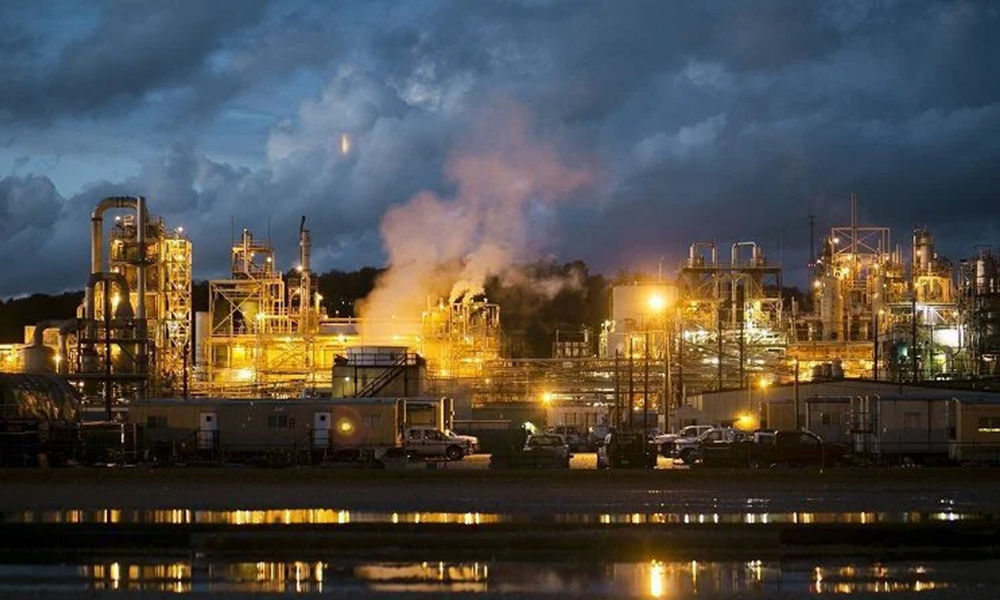
The Washington Works chemical facility near Parkersburg has been a national hot spot for PFAS pollution through groundwater and air since PFAS use began there under DuPont control in 1951.
And it was the Washington Works facility behind much of the reported pollution that drove the proposed settlement announced Wednesday by the DOJ alongside the U.S. Environmental Protection Agency and West Virginia Department of Environmental Protection.
The multistate settlement, not yet approved by the West Virginia federal court in which it’s been proposed, covers four Chemours facilities in West Virginia, North Carolina and New Jersey in what the DOJ called the first comprehensive settlement by the federal government to resolve enforcement claims over pollution by a manufacturer of PFAS.
The DOJ says Chemours violated:
- The federal Clean Water Act by releasing certain PFAS without or in violation of a water pollution control permit
- The federal Toxic Substances Control Act by not adhering to recordkeeping provisions and unlawfully manufacturing and processing PFAS
- The Resource Conservation and Recovery Act, which governs disposal and management of hazardous waste, by accepting shipments of such waste in violation of a permit and unauthorized storing of such waste
Under the proposed agreement, Chemours would pay a civil penalty of $22.5 million for alleged violations and conduct a multi-year, $90 million program to limit PFAS discharges.
Chemours also would install PFAS pollution controls for surface water discharges and air emissions at the Washington Works facility at an estimated cost of $60 million, supply clean drinking water for over a decade to communities that surround its facilities in West Virginia and New Jersey at an estimated cost of $280 million, and assess options and implement corresponding controls to decrease releases of PFAS and other toxic chemicals from its facility in North Carolina.
The costs of the penalty and injunctive relief programs are estimated to total more than $450 million.
The proposed settlement would allow Chemours to continue manufacturing PFAS for what the DOJ called critical commercial and military applications, the agency said.
Morrisey: W.Va. ‘engaged’ on more Chemours site resolution
In a statement released by the DOJ, West Virginia Gov. Patrick Morrisey said that as the state’s attorney general, his post from 2013 to 2025, his office investigated Chemours and “took crucial steps needed to reach this settlement and position the state to reach justice for West Virginians,” adding the state “would continue to ensure that every company complies with our laws.”
Morrisey had been noncommittal as attorney general and governor on pursuing legal action against Chemours in response to multiple Gazette-Mail inquiries on the subject since 2023 as other states reached settlements with Chemours and other manufacturers over PFAS pollution.
One of those deals was a $110 million settlement agreement DuPont de Nemours, Inc., announced in 2023 that it, Chemours and Corteva, Inc. reached with Ohio over what the state noted was chemical contamination spanning seven decades from the Washington Works facility. Chemours took over control of the facility from DuPont in 2015.
Another deal was a $2 billion-plus settlement accord New Jersey state officials announced last year in which the companies — including Chemours and DuPont — agreed to fully clean up contamination at four New Jersey sites and to pay $875 million over 25 years in natural resource and other damages.
West Virginia is more reliant on federally set maximum contaminant levels because of its relative dearth of state oversight.
At least 16 states have adopted guidance, health advisory or notification levels for certain PFAS, and 11 have established enforceable standards, according to an estimate by Safer States, a national alliance of environmental health groups and coalitions.
West Virginia is not among them.
“This settlement is an encouraging first step, but it addresses only one piece of a much larger issue,” Morrisey said in his statement Wednesday. “We remain actively engaged in discussions to reach a comprehensive resolution for the Washington Works facility that protects our citizens and ensures West Virginia’s communities have confidence that these issues are being addressed for the long term. We look forward to continuing those discussions and achieving an outcome that serves the best interests of the Mountain State.”
Washington Works’ long toxicity history
The complaint against Chemours alleges the drinking water of tens of thousands of people near the Washington Works facility, the company’s Fayetteville Works in Fayetteville, North Carolina, and Chambers Works in Deepwater, New Jersey, were affected during a decade of violations, with Clean Water Act permit-violating discharges into the Ohio, Cape Fear and Delaware rivers, respectively.
The DOJ noted the facilities were previously owned for decades by DuPont and that Wednesday’s proposed settlement doesn’t resolve DuPont’s PFAS liability.
In 1951, DuPont began using perfluorooctanoic acid, one of the most common PFAS, known as PFOA, to make Teflon-related products at its Washington Works facility near Parkersburg. The chemical discharged into drinking water supplies.
People living in the area experienced increased rates of testicular and kidney cancer, thyroid disease, ulcerative colitis and pregnancy-induced hypertension.
The EPA later said DuPont failed for more than two decades to report data indicating PFAS health risks from manufacturing at the Washington Works plant. The company agreed to pay $10.25 million for reporting violations in 2005 in what the EPA then said was the largest civil administrative penalty it ever obtained under a federal environmental statute.
In 2017, DuPont joined Chemours in agreeing to pay $670 million to settle 3,500 PFOA personal injury claims. Chemours was formed as a spinoff of DuPont’s performance chemicals division in 2015.
DuPont and 3M documents collected by the Environmental Working Group, a nonprofit advocacy group, show the companies conducted animal studies revealing PFAS toxicity in the 1950s and 1960s. In 1979, a DuPont survey found that PFOA-exposed workers may have suffered liver damage and had a higher rate of myocardial infarctions than the company-wide population.
The proposed agreement announced Wednesday calls for 14 specified projects to decrease PFAS in wastewater, stormwater and groundwater from the West Virginia plant, including treatment systems using granulated activated carbon.
Per the planned accord, for people drinking water near the West Virginia and New Jersey facilities, Chemours would test the drinking water and provide treated or alternative clean water. Chemours also would be required to control releases of the chemical compound GenX, which is used to make plastics, from each facility at an efficiency of at least 99%. The programs are set to last for 15 years.
The EPA this month proposed to eliminate a legally enforceable contamination level it set in 2024 for GenX chemicals, also known as HFPO-DA (hexafluoropropylene oxide dimer acid). It also proposed to allow for a two-year extension of compliance deadlines set in 2024 for PFOA and another common cancer-linked PFAS, PFOS (perfluorooctanesulfonic acid), drawing the ire of water quality advocates.
Half of $22.5M civil penalty amount to go to two DEP funds
Chemours and DuPont had been subject to a 2017 EPA consent order regarding the Washington Works facility in which they agreed to offer temporary alternate drinking water supplies within 14 days or as soon as practicable for private and public water systems with levels of PFOA above 70 parts per trillion in their treated water and provide for operation and maintenance of granulated activated carbon treatment systems for source water in the system exceeding 70 parts per trillion for four straight quarters.
The EPA had established a nonregulatory health advisory level, which identifies the concentration of chemicals in drinking water at or below which adverse health effects aren’t expected to occur, of 70 parts per trillion for PFOA in 2016. But in 2022, the EPA dramatically lowered that health advisory level to 0.004 parts per trillion.
Funding for projects under Wednesday’s proposed agreement would be capped at $90 million over 15 years plus applicable interest, with the EPA allowed to identify and provide to Chemours proposed projects in addition to projects identified by the company. Chemours could dispute EPA-chosen projects the company doesn’t agree to via judicial review before the federal court.
By July 31 and Jan. 31 of each year after the consent decree’s effective date, Chemours would have to email a semi-annual report for the preceding six months that includes the status of any construction or compliance measures being taken under the accord, completion of milestones, problems encountered or expected, and status of permit applications.
Late payment of a civil penalty, or any applicable installments or interest from days one through 14 of tardiness, would cost $5,000 per day, $10,000 per day from the 15th through 20th days of tardiness and $20,000 per day for the 31st day of lateness and beyond.
Asked for comment on the proposed agreement, a Chemours spokesperson referred to a news release on it in which Chemours said the accord recognizes that Chemours already has started planning and implementing operational improvements and remedial measures at its sites and contains additional actions it will take to limit future emissions.
The proposed agreement would require Chemours to pay $22.5 million as a civil penalty in three annual payments of $7.5 million, with the first payment due by 30 days after the effective date.
The proposed accord says that factors considered in calculating the civil penalty include Chemours’ “good faith cooperation” with the EPA, DEP and other agencies, and remedial measures already taken by the company.
The planned agreement says federal authorities determined Chemours, which in February reported net sales totaling $5.8 billion and an adjusted net income of $143 million for 2025, had a “limited ability to pay the total civil penalty the United States could seek for the violations alleged in this case.”
Half of the penalty amount would be paid to the state of West Virginia, with $11 million of the civil penalty to go to the DEP’s Water Quality Management Fund and $250,000 to go to the DEP’s Hazardous Waste Management Fund.
W.Va. Rivers: Pact ‘meaningful step’ building on citizen suit
Jennie Smith, executive director of the West Virginia Rivers Coalition, a statewide water restoration nonprofit, said her group was especially encouraged by commitments to install additional treatment systems, reduce PFAS releases, provide drinking water protections and invest in long-term mitigation efforts.
“This settlement represents a meaningful step toward reducing pollution at its source, improving compliance with environmental laws, and providing protections for affected communities,” Smith said in an email.
The proposed agreement follows a December 2024 federal lawsuit from the Rivers Coalition against Chemours that resulted in a preliminary injunction to stop the company from discharging HFPO-DA beyond pollution limits set by its permit.
“Chemours has treated its permit more as full permission to act without constraint,” U.S. District Court for the Southern District of West Virginia Judge Joseph Goodwin, nominated to his seat in 1995 by then-President Bill Clinton, wrote in the order, finding in an August 2025 order that Chemours “boldly violates” its permit and left the public “exposed to real and ongoing harm.”
But three Court of Appeals for the Fourth Circuit judges, two nominated by President Donald Trump and one by former President George H. W. Bush, tossed that decision this month, ruling that the district court erred in finding “irreparable harm” from the company’s Washington Works plant.
Smith said this month, though, that the injunction “did its job” in enforcing compliance. Jim Hecker, senior environmental enforcement attorney at Public Justice, a Washington, D.C.-headquartered law firm that co-represented the Rivers Coalition in the case, said in a statement Wednesday the feds’ complaint and subsequent proposed settlement “piggy-back” on the group’s lawsuit filed last year.
Hecker observed that Chemours has complied with the injunction and stopped violations at two discharge points.
“The United States decree builds on that progress and demonstrates the power of citizens coming together to demand accountability through our legal system,” Hecker said.
“[The] settlement demonstrates the value of that citizen enforcement role,” Smith said, “and what can be accomplished when communities, advocates and government agencies work toward a common goal.”
Read more from HDMedia, here