


By Rachel Brosky
For WVU, Today
A new robotic gripper designed to pick fruit could mean supermarket shoppers enjoy better quality produce as well as new options like pawpaws, a West Virginia University researcher said.
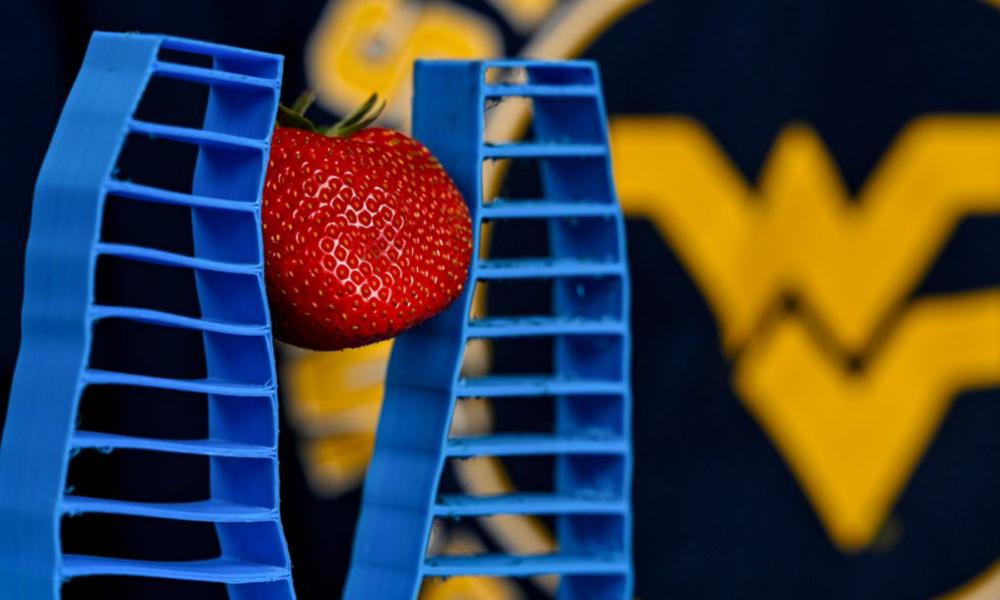
Anand Mishra, assistant professor in the Department of Mechanical, Materials and Aerospace Engineering at the WVU Benjamin M. Statler College of Engineering and Mineral Resources, was part of a team of roboticists behind the development of a soft gripper capable of gauging the size, curvature, color and ripeness of fruits like strawberries and avocados.
He said the gripper’s soft “fingers,” made of silicone and polyurethane, handle delicate fruits gently, while multiple sensors enable precise decisions about which fruits are ripe for harvest.
“Our gripper’s quick, accurate inspections and harvesting can reduce spoilage of fruits and lower supply chain costs,” Mishra said. “Fruit inspections are critical for harvesting decisions that have traditionally been made by human workers. However, using human workers for harvesting involves challenges such as labor shortages, health concerns and inaccuracies in picking.
“Recently, robots have emerged as a promising technology to reduce spoilage and improve distribution efficiency. But most current robotic systems are designed for indoor greenhouse applications, even though over 99.9% of crops are cultivated in outdoor environments. And rigid robotic systems can bruise ripe fruit with their bulky, hard grippers, while struggling with sensor reliability.”
In contrast, he explained, his team’s soft robotic gripper can inspect the fruit with both tactile and visual sensors that identify the perfect time for picking, and it can harvest a fruit like a strawberry simply by twisting the stem, no cutting required.
In a paper in Nature Communications, Mishra and his coauthors detail their findings from research originally conducted in the Organic Robotics Lab of Rob Shepherd at Cornell University, and now continuing in Mishra’s WVU lab.
The five-fingered gripper they developed looks and acts like a hand — but it also resembles a starfish. Mishra said those associations with natural organisms aren’t accidental.
“My research group at WVU is called the Robiotics Lab because we focus on robots that mimic biology. We design squishy, squeezy, rubbery robots inspired by animals. These robots move differently than traditional hard robots. Imagine a robot that moves like an octopus, for example. Because our robots are soft, they absorb vibrations and mechanical forces differently than traditional robots. And their tactile sensing is different in the way they touch objects and discern pressure and shape.”
Those qualities are important for fruit farmers because ripeness is a major challenge in farm-to-market distribution. While some crops, like citrus fruits, can be commercially harvested over a period of weeks, others like strawberries and raspberries have a window of only a day or two. Making it harder, those fruits with shorter ripening periods are usually soft with thin skin, meaning they bruise and spoil easily. Strawberry farmers, for instance, can see post-harvest losses of up to 25%.
But because many fruits, such as avocados, don’t reliably look different after ripening, visual assessments aren’t enough. Robots, like humans, often need to squeeze a fruit to know how ripe it is. In addition to driving significant financial losses for farmers and retailers, the difficult question of when to harvest means that some fruits, like the delicate, quick-to-spoil pawpaw, can’t be successfully distributed beyond their local areas.
The soft robotic gripper Mishra and his colleagues developed can mitigate those challenges. Within each of its fingers, stretchable optical fibers serve as tactile and curvature sensors, while the palm houses a miniaturized camera and distance sensor. After testing the gripper on supermarket strawberries and then a living strawberry plant, the researchers showed the gripper can open and close in under two seconds, lift weights of up to a kilogram — more than 16 times its own weight — and achieve nearly 100% accuracy in shape prediction. It can sense not only stiffness and bending, but also slipping, so it can detect when its grasp on a fruit is unstable.
While the gripper’s multifunctional soft sensing system is focused on reducing food waste and financial losses in agricultural supply chains, Mishra pointed to uses beyond fruit harvesting, and even beyond farming.
“This system offers applications in space exploration, health care, food handling and underwater manipulation,” he said. “In biomedical robotics, for instance, the integration of curvature and tactile sensing could enhance wearable and rehabilitation devices. There are many possibilities inherent in the technology’s capacity for multi-object grasping, manipulation and environment interaction. Like the animals they’re based on, soft robots can adapt to new situations.”
Read more from WVU, Today, here.