



By Erik Rudolph
For WVU, Today
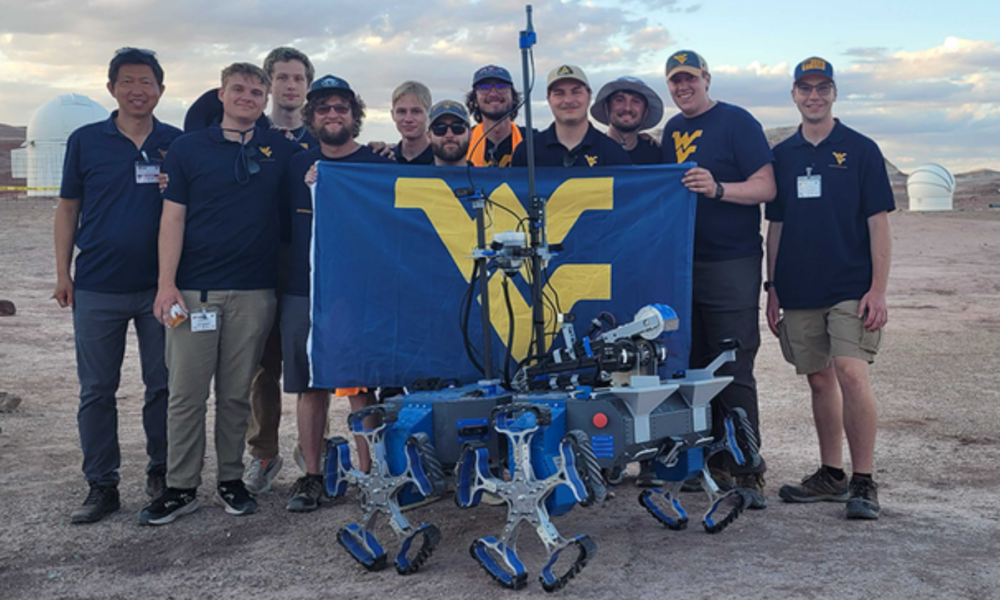
Demonstrating technical precision and adaptability in one of the world’s premier student robotics competitions, a team of students from the West Virginia University Benjamin M. Statler College of Engineering and Mineral Resources placed fourth overall at the 2026 University Rover Challenge, while earning first place in the System Acceptance Review and tying for first in the autonomous navigation mission.
Morgantown — The WVU URC robotics team members Evan Anderson, Ian Long, Logan Gold, Tanner Forbes, Ryan Ostrander, Parker Vance, Izaak Whetsell, John Winter, Caleb Edwards, Tucker Wilson and Camndon Reed represented WVU at the 2026 University Rover Challenge, held May 27-30 at the Mars Desert Research Station in Utah.
Gold and Whetsell served as team leads for this year’s competition.
The University Rover Challenge is an international robotics competition that challenges college students to design and build the next generation of Mars rovers. This year, 38 finalist teams from 11 countries advanced to the competition after a record 116 teams from 18 countries began the year competing for a spot in the finals.
Before the final competition, WVU earned first place in the System Acceptance Review, a key evaluation that required teams to demonstrate the readiness, reliability and integration of their rover systems. During the field competition, WVU also tied for first place in the autonomous navigation mission.
“I know myself and all of our team members were extremely happy with the results of the competition,” Gold said. “We are proud and feel gratified that the thousands of hours of work the team put into our rover, Deimos, paid off and were reflected in the competition results.”
This year’s rover featured a fully integrated design capable of completing all four competition missions with minimal hardware changes, improving testing logistics, system reliability and overall performance in the field.
“This year, the team made many improvements across the rover, but one of the most important was developing a fully integrated system that could complete all four missions with minimal hardware changes,” Yu Gu, Mechanical, Materials and Aerospace Engineering Academy of Distinguished Alumni Professor, said. “That improved our testing logistics, strengthened system reliability and allowed the students to focus on mission execution in the field.”
The rover also included several design, software, communication and algorithm improvements, along with a unique wheg, or wheel-leg, mobility system that gave the robot strong movement capabilities while keeping the design simple and robust.
Gold said the rover’s whegs were one of the features he was most proud of this year.
“Late in the year, we made a switch from composite whegs to aluminum whegs, which not only improved the strength but also decreased the weight of the system,” Gold said. “This allowed us to navigate over most of the competition terrain without any issues and with fewer concerns from the operators.”
The team has open-sourced its rover design for the last three years and plans to continue doing so this year, helping newer teams learn from WVU’s approach and build stronger systems of their own.
At the end of the competition, Gold said multiple teams thanked Team Mountaineers for making its documentation publicly available, including one team that said it would not have made it to the competition without WVU’s open-source materials.
“It was also fun to see how many teams had borrowed design decisions that we made,” Gold said. “These comments validate our team’s efforts to lower the barrier to entry for new teams.”
The competition required students to complete missions that tested equipment servicing, autonomous navigation, science capabilities and other systems in a desert environment designed to mirror the challenges of planetary exploration.
One of the team’s most challenging moments came during the equipment servicing mission, which began early in the morning after the students left their Airbnb at 5:30 a.m. to prepare for a 7:40 a.m. start. During the mission, a USB-C cable was damaged during the USB insertion task, leading to additional damage to several cameras and two motors.
Despite those setbacks, the students adapted quickly, solved problems remotely and completed several tasks after the initial issues.
“The equipment servicing mission was one of the most challenging parts of the competition for the team,” Gu said. “It started early in the morning, and the students had to work through several issues after a damaged USB-C cable led to additional damage to cameras and motors on the rover. Even with those setbacks, they adapted quickly, solved problems remotely and were able to complete several tasks.”
Gold said the team could not have predicted that sequence of issues, but each operator’s preparation helped the team continue working through the mission.
“Each operator is required to train at least 30 hours on the robot, which means even when we have issues during the mission, we have the experience to be able to get as many points as possible with what we do have left,” Gold said. “Even after the failure of the USB-C and cameras, we were still able to scrape together almost 22.5 points.”
The team brought together students from mechanical engineering, robotics engineering, computer science, computer engineering, electrical engineering and chemistry, reflecting the interdisciplinary nature of modern robotics.
For students, the University Rover Challenge provided experience that closely mirrors real-world engineering conditions, where systems must operate reliably in harsh environments and teams must prepare carefully while remaining flexible when unexpected issues arise.
Gold said one of his biggest takeaways from the competition was learning how to respond when unexpected challenges arise.
“Unexpected things will always occur, but it is up to you to prepare yourself on how to react and adapt to those surprises,” Gold said.
“This is one of the best opportunities students have to experience real-world engineering, teamwork and leadership,” Gu said. “The desert environment and competition missions are not forgiving, so students learn the importance of careful planning, system reliability and not taking anything for granted.”
WVU robotics and Team Mountaineers have also helped increase the visibility of robotics at WVU and the state. In recent years, more than 80 WVU students have been involved in the University Rover Challenge through various technical, leadership and support roles with robotics faculty and staff being integral in delivering various outreach K-12 events, camps and workshops throughout the state.
Past students involved with the team have gone on to secure employment with companies such as SpaceX and Blue Origin, earn awards and fellowships, and pursue graduate education.
“I think our competition results show that WVU robotics can compete on the international stage and that Statler College students are prepared for the real world,” Gold said.
The University Rover Challenge is a project of The Mars Society and challenges student teams to design and build rovers that could one day assist astronauts during field operations on Mars.
Read more from WVU, Today, here.